Key Takeaways:
- Graduates often enter the workforce with strong academic knowledge but limited real-world skills.
- Employers now prioritise communication, collaboration, adaptability, and problem-solving from day one.
- Malaysia’s MADANI Graduate Scheme (SGM) supports industry readiness, but experiential learning accelerates practical skill development.
- Team building bridges classroom learning and workplace expectations through hands-on, reflective experiences.
- Skill-focused activities help graduates build confidence, emotional resilience, and workplace ownership.
- A structured roadmap—from onboarding to end-programme leadership—makes team building more impactful.
- Blending workshops with experiential challenges drives faster behaviour change and job readiness.
Introduction
Stepping out of university and into a full-time role is a big leap for any graduate. Every year, more young talents enter the workforce with solid academic knowledge, but many still struggle with the “real-world” skills needed to thrive in corporate environments.
For employers, especially HR and L&D leaders, the challenge is about helping them transition smoothly from classroom learning to workplace performance.
This is where well-designed team building plays a powerful role. When done right, it becomes a practical bridge between theory and real-world application, helping graduates build confidence, collaboration, and ownership on the job.
In Malaysia, initiatives like the MADANI Graduate Scheme (SGM) further highlight the country’s focus on graduate employability and industry readiness.
While schemes like SGM create structured pathways into the workforce, team building adds another crucial layer—giving graduates hands-on, experiential learning that accelerates their integration into teams and organisational culture.
Why Graduate Skill Development Matters Now?

A degree is still important, but today, it’s no longer enough on its own.
Employers in Malaysia and globally are looking for graduates who can perform, not just those who can pass exams. That means skills like communication, collaboration, problem-solving, and resilience are now just as valuable as technical knowledge.
A few realities driving this urgency:
- Competition for jobs is higher than ever: Graduates aren’t just competing with peers from their own universities, but also with international graduates, experienced hires, and even AI-powered tools. Those who can adapt quickly and contribute meaningfully stand out fastest.
- Employers expect work-ready skills from day one: Many organisations now expect fresh hires to communicate clearly, work in teams, manage deadlines, and handle feedback—without needing months of basic adjustment. Soft skills are no longer “nice to have”; they’re part of job readiness.
- Skills, not just knowledge, drive performance and retention: Graduates who can manage conflict, solve problems, and take ownership tend to integrate faster, contribute more, and stay longer. This reduces friction for managers and improves team performance.
This is very much aligned with the intention behind Malaysia’s MADANI Graduate Scheme (SGM), which aims to strengthen workforce competitiveness and close the gap between education and industry needs.
Where schemes like SGM create structured exposure and training, organisations can further amplify results with targeted, skill-focused team building that turns learning into real behaviour change.
From Classroom Knowledge to Workplace Skills – Where the Gaps Are
Most graduates leave university with strong theoretical knowledge. But when they enter the workplace, many discover a different reality. The way work gets done is rarely the way it was taught in class.
Here are some of the most common gaps L&D and graduate programme managers see:
- Communication gaps: Graduates may write good assignments, but struggle with real-world communication, like updating stakeholders, writing concise emails, or speaking up in meetings.
- Teamwork and collaboration: Group projects at university are not the same as working in cross-functional teams with different roles, deadlines, and expectations. Some graduates find it hard to share responsibility and manage conflicts.
- Ownership and accountability: In class, the “worst case” is a lower grade. At work, missed deadlines and errors affect clients, revenue, and team performance. Taking full ownership of tasks is a big shift for many.
- Problem-solving and critical thinking: University problems often come with clear instructions. Workplace problems don’t. Graduates need to learn how to ask the right questions, prioritise, and make decisions with limited information.
- Adaptability and resilience: Work environments change fast — new tools, new priorities, new managers. Some graduates feel overwhelmed when things don’t go as planned or when feedback is direct and frequent.
Traditional classroom-style induction or pure e-learning rarely fixes these gaps. Graduates hear about communication, teamwork, or resilience, but they don’t always get to practise these skills in a realistic setting.
This is where experiential approaches, like structured team building, become important. They create a safe space for graduates to try, fail, adjust, and learn — before those behaviours are tested in front of clients, leaders, or senior stakeholders.
How MADANI Graduate Scheme (SGM) Supports Graduate Development?
The MADANI Graduate Scheme (SGM) is a national initiative managed by HRD Corp to help fresh graduates gain real industry exposure, structured training, and better job readiness.
It focuses on matching graduates with employers who can provide on-the-job learning, guidance, and development.
Through SGM, graduates are placed into roles where they receive structured training, coaching, and industry-relevant experience over a defined period. This helps them build practical skills such as communication, teamwork, problem-solving, and professionalism that are often not fully developed in university.
For employers, SGM is designed to strengthen Malaysia’s overall workforce competitiveness by closing the gap between education and industry needs.
Team building programmes can work alongside schemes like SGM by accelerating soft-skill development, improving confidence, and helping graduates integrate faster into existing teams.
Also read:
- MADANI Graduate Scheme (SGM) – What We Know So Far
- How Can HR Leaders Adapt the MADANI Scheme to Strengthen Graduate Integration
Why Team Building Is Powerful for Graduate Skill Development?
When fresh graduates join a company, they often know what to do on paper, but not how to work with people, handle pressure, or navigate real-life situations at work. This is where well-designed team building becomes very powerful.
Unlike a classroom or online course, team building for graduates is:
- Experiential, not theoretical: Graduates don’t just hear about teamwork or communication, they experience it through group challenges, debriefs, and reflection.
- Safe practice for real workplace situations: Team challenges simulate real work conditions: deadlines, limited resources, unclear instructions, and different personalities. Graduates learn to ask questions, clarify expectations, and support one another.
- A fast track to confidence and belonging: When graduates solve problems together, they build psychological safety. They feel more comfortable speaking up, sharing ideas, and admitting when they need help.
- A bridge between generations: If designed well, team building can mix graduates with more experienced staff. This helps new hires understand company culture faster and learn how to work with different working styles and expectations.
Done right, team building is not a “fun day out”. It’s a structured environment where graduates practise communication, collaboration, and resilience in ways that directly support their day-to-day roles.
Also read: What is Corporate Team Building and How to Make Employees Actually Want to Participate
Team Building Activities That Build Graduate-Ready Skills
Not every game is suitable for graduate development. The most useful team-building activities are those designed around specific skills. Here’s how you can think about it.
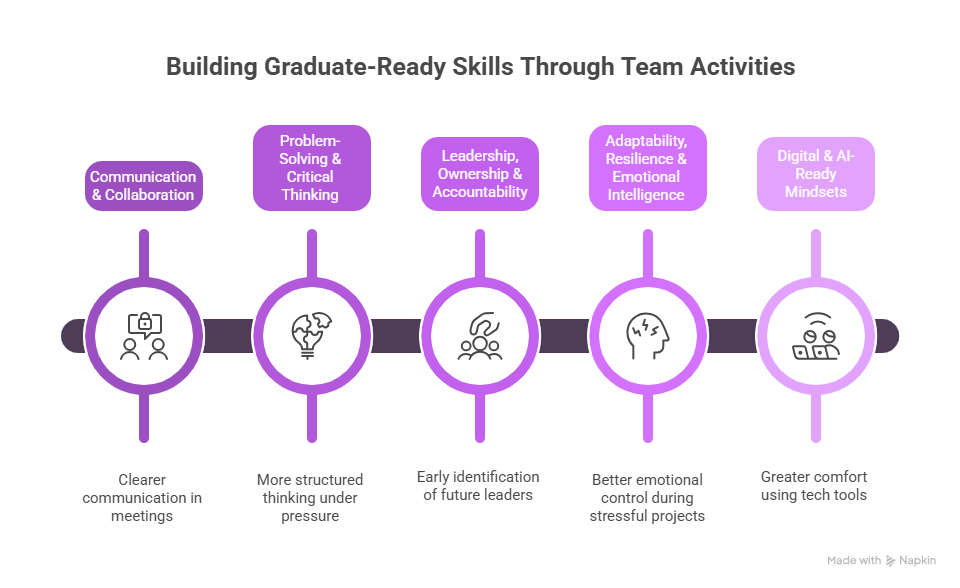
Image: Team Building Activities
Communication & Collaboration
Graduates often struggle to speak up clearly, ask questions, or coordinate with others.
Good activity types:
- Tasks where one person has information and others must execute based on their instructions.
- Group challenges that require planning together before acting.
- Activities where teams must present their final solution or ideas.
Outcomes:
- Clearer communication in meetings.
- Better listening and fewer misunderstandings.
- More willingness to share updates and ask for clarification.
Problem-Solving & Critical Thinking
Many graduates are used to exams, not messy real-world problems.
Good activity types:
- Scenario-based games with incomplete information.
- Time-bound puzzles where teams must prioritise steps.
- Challenges that have multiple possible answers, not just one.
Outcomes:
- More structured thinking under pressure.
- Better prioritisation of tasks and resources.
- Stronger decision-making in unclear situations.
Leadership, Ownership & Accountability
Even if they are not managers yet, graduates need to take ownership of their work.
Good activity types:
- Rotating team leader roles in each challenge.
- Activities where someone must coordinate roles, timelines, and next steps.
- Reflection sessions where leaders share what they did well and what they’d change.
Outcomes:
- Early identification of high-potential future leaders.
- Greater sense of responsibility for tasks and deadlines.
- More initiative instead of waiting for instructions.
Adaptability, Resilience & Emotional Intelligence
Work rarely goes exactly to plan and graduates need to handle change and stress calmly.
Good activity types:
- VUCA-style simulations where rules or objectives change mid-activity.
- Challenges where teams face “setbacks” and must redesign their approach.
- Debriefs that focus on emotions, reactions, and coping strategies.
Outcomes:
- Better emotional control during stressful projects.
- Stronger resilience when plans change or feedback is tough.
- A more solution-focused mindset instead of blame or withdrawal.
Digital & AI-Ready Mindsets (Optional)
Many roles now require comfort with digital tools and emerging technologies.
Good activity types:
- Team tasks that involve using shared digital boards, collaboration tools, or simple AI helpers.
- Activities that require researching, summarising, or presenting using digital platforms.
Outcomes:
- Greater comfort using tech tools as part of everyday work.
- Curiosity about AI, automation, and smarter ways of working.
- A mindset that sees technology as a support, not a threat.
Also read: Why AI in Corporate Training Is the Next Big Shift for HR & L&D Teams
Designing a Team Building Roadmap for Graduate Programmes

A strong graduate programme doesn’t treat team building as a one-off event. It weaves experiential learning throughout the entire journey. Here’s a simple way to structure it:
Step 1 – Define Graduate Competency Outcomes
Start by identifying the core skills your graduates need to succeed—communication, problem-solving, teamwork, stakeholder management, adaptability, and ownership.
Align these competencies with your organisation’s internal frameworks and industry expectations so every activity supports real workplace performance.
Step 2 – Integrate Team Building Into the Graduate Journey
Position team building at the right touchpoints:
- Onboarding: Ice-breaking sessions and culture immersion to build early confidence and belonging.
- Mid-programme: Activities that strengthen collaboration, cross-functional teamwork, and resilience.
- End of programme: Leadership-focused tasks and reflection exercises that prepare graduates for their next career steps.
Step 3 – Blend Workshops with Experiential Team Challenges
Combine short workshops (to introduce concepts and models) with hands-on challenges (to practise behaviours in realistic situations). This blended approach turns learning into action, speeds up behaviour change, and ensures graduates apply what they learn in their day-to-day roles.
How Thriving Talents Supports Graduate Skill Development
For HR and L&D leaders running graduate programmes or adopting the MADANI Graduate Scheme (SGM), having the right development partner makes all the difference.
Thriving Talents supports organisations by designing team-building experiences that do more than entertain—they build real, workplace-ready behaviours.
Here’s how we help strengthen graduate integration and performance:
- Customised graduate team building aligned with your competency framework: We map every team-building module to the exact competencies you want to develop (communication, collaboration, critical thinking, or leadership).
- Hybrid learning formats for deeper behaviour change: Our approach blends short workshops (to teach models and concepts) with experiential team challenges (to help graduates practise these behaviours in real scenarios).
- Experience with management trainee & long-term development programmes: We’ve worked with organisations across Malaysia on graduate academies, management trainee pipelines, and SGM-aligned initiatives. This allows us to design activities that match your internal culture while still stretching graduates to grow.
- Data-backed improvement & behavioural insights: Each programme includes observations, feedback, and recommendations based on graduate performance during activities. HR leaders receive practical insights they can use to coach graduates throughout the year.
Also read: How to Maximise Your HRD Corp Levy with Strategic Team Building Programs
Conclusion
Degrees help graduates enter the workforce. But it’s their skills, behaviours, and adaptability that help them succeed.
As employers face higher expectations, tighter competition, and faster-changing workplaces, practical skill development is no longer optional.
Team building, when designed as experiential learning, gives graduates the space to practise communication, collaboration, problem-solving, and resilience before these skills are tested on real projects. It turns theory into action and helps new hires integrate faster into teams and organisational culture.
For L&D leaders, HR teams, and programme managers, the message is clear: Invest early in the skills that matter most. Build team building into your graduate journey—not as a fun activity, but as a strategic learning tool.
If you’re looking to equip your next graduate cohort with the right workplace-ready skills, reach out to us at Thriving Talents for a free consultation. We’d be happy to help you design a structured team-building plan tailored to your organisation.


