Key takeaways:
- A sales training needs assessment ensures you solve the right performance gaps, not just deliver more training.
- It helps align training efforts with business goals like revenue growth, market expansion, and customer retention.
- Assessments identify whether the root problem lies in skills, behaviours, processes, or leadership.
- Using a mix of data, conversations, and observation gives a complete view of the sales team’s capability.
- A four-step framework—define goals, assess performance, identify gaps, prioritise actions—keeps the process focused.
- Needs assessments should be done regularly, especially during team changes or market shifts.
- At Thriving Talents, we design award-winning programmes grounded in diagnostics and tailored for measurable outcomes.
Introduction
Many sales training programmes fail to deliver long-term results; not because the content is poor, but because the wrong problems are being solved. Too often, organisations jump into workshops without fully understanding what’s actually limiting sales performance.
This is especially risky in Malaysia, where approximately 64% of organisations face moderate to extreme skill shortages, with competition from other employers intensifying the pressure to build the right capabilities internally.
The real cost isn’t just budget wasted. It’s time, morale, and lost revenue opportunities. Before investing in capability development, businesses must begin with clarity, context, and a structured diagnostic process.
A training needs assessment ensures you’re not just doing training, but doing the right training.
What Is a Sales Training Needs Assessment?
A sales training needs assessment is a structured process designed to help organisations evaluate their current sales performance, uncover capability gaps, and align training efforts with business goals. It shifts the focus from guesswork to data, from assumption to insight.
Most importantly, it helps identify whether training is even the right solution—or whether the root causes lie elsewhere, like leadership gaps, unclear processes, or misaligned incentives.
Also read: What Is Sales Training? A Complete Guide for Malaysian Corporates
Sales Training Needs Assessment vs. Sales Training Needs Analysis
While the terms are often used interchangeably, they serve different purposes. A needs assessment is a focused, action-oriented diagnostic step used to uncover performance issues and prioritise development needs.
In contrast, a training needs analysis is often a broader and more detailed process that includes extensive data collection and long-term planning. For most businesses, starting with a quick, well-executed needs assessment is what drives the most immediate impact.
Also read: Traditional vs Modern Sales Training Methods: Which Works Better in Malaysia.
Why Is a Sales Training Needs Assessment Important?
Not all sales challenges are caused by skill gaps, and not all training delivers impact. Let’s look at why a needs assessment is the critical first step to ensure your sales development efforts are focused, effective, and aligned with business goals.
Aligning Sales Capability With Business Strategy
An effective needs assessment ensures that sales training efforts are directly tied to business goals like revenue growth, market expansion, or improved customer retention. It prevents teams from wasting resources on training that feels disconnected from strategic outcomes.
Identifying Root Causes, Not Just Symptoms
Sales slumps aren’t always caused by skill deficits. Sometimes the real issues lie in outdated processes, inconsistent coaching, or poor team dynamics. A proper assessment helps uncover these less-visible barriers so interventions address the real problem—not just the symptoms.
Maximising the Impact of Sales Training Investments
Training is most effective when it’s targeted, relevant, and timed well. A diagnostic-first approach leads to better learner engagement, stronger adoption, and higher return on investment.
When Should You Conduct a Sales Training Needs Assessment?
Before launching any sales training initiative, it’s important to assess your team’s actual needs. Here’s when to prioritise it:
- Before rolling out new sales training or workshops
- During growth phases, restructuring, or strategy shifts
- When sales performance plateaus or declines
A sales training needs assessment should also be treated as an ongoing discipline, not a one-off activity. Regular insights help sales leaders refine development efforts, track progress, and respond to market changes.
Also read: Scaling Your Sales Team: What to Fix Before You Hire.
A Practical Framework to Conduct a Sales Training Needs Assessment
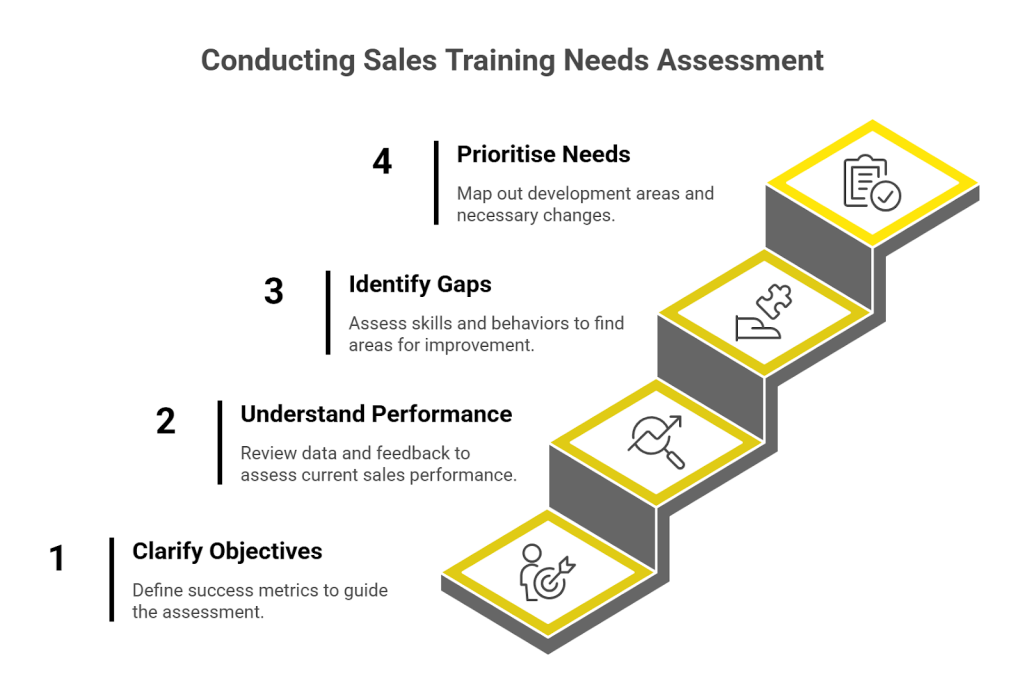
Image: A four-step framework to conduct a sales training needs assessment
Conducting a sales training needs assessment doesn’t have to be complex, but it does need structure. Let’s walk through a four-step framework that ensures your efforts are focused, evidence-based, and aligned to real business outcomes.
Step 1: Clarify Business and Sales Objectives
Begin by defining what success looks like. Is your goal to improve win rates, shorten sales cycles, or enter new markets? Establishing these objectives helps guide your assessment and prioritise what matters most.
Step 2: Understand Current Sales Performance
Review key data: sales KPIs, pipeline conversion metrics, average deal size, and team performance breakdowns. Complement the numbers with qualitative feedback from sales leaders, managers, and frontline reps.
Step 3: Identify Capability and Behavioural Gaps
Assess both the hard skills (e.g. objection handling, discovery techniques) and the soft behaviours (e.g. mindset, consistency, resilience) that drive high performance. Identify where gaps exist between average and top performers.
Step 4: Prioritise Needs and Define Focus Areas
Not every performance gap requires training. Some may need process changes, better tooling, or role clarity. Use the assessment insights to map out what needs development, what needs coaching, and what needs system-level change.
This framework gives sales leaders a clear path from insight to action—ensuring that any training investment is both targeted and effective.
Methods and Tools Used in Sales Training Needs Assessment
Sales training needs assessments are most effective when they combine data with human insight. Here are four commonly used methods:
- Surveys and self-assessments: Quickly gather broad insights on confidence levels, perceived skill gaps, and training needs across the sales team.
- Interviews and stakeholder conversations: Offer deeper context by capturing leadership perspectives and uncovering hidden barriers that metrics may miss.
- Sales performance and CRM data: Reveal performance trends and validate assumptions using conversion rates, deal size, and pipeline metrics.
- Observation and real-world selling scenarios: Provide a firsthand view of sales behaviours, allowing teams to assess skills in action—not just on paper.
Why a Diagnostic-First Approach Leads to Better Sales Training

Effective sales training begins long before a single session is delivered. A diagnostic-first approach ensures that every development effort is guided by evidence—not assumptions—so that training addresses actual performance gaps rather than perceived ones.
By starting with structured assessment, organisations gain a clear view of what’s truly holding teams back. This allows sales workshops to be designed around real challenges, making them far more relevant, focused, and impactful.
Rather than delivering generic content, training becomes tailored to the specific skills, behaviours, and scenarios your sales team encounters daily. As a result, participants are more engaged, and the learning is more likely to be applied in practice.
This approach also leads to longer-lasting performance improvement. Because the training is grounded in a business context and directly tied to sales objectives, it reinforces behaviours that support measurable outcomes.
At Thriving Talents, this diagnostic-first mindset is core to how we partner with organisations. We start by understanding your team, your goals, and your challenges, so the solutions we build are not just effective but aligned, actionable, and built to last.
FAQ
What questions should be asked in a sales training needs assessment?
Questions should focus on performance challenges, current capabilities, sales confidence, customer engagement, and where deals are lost or delayed.
How often should sales training needs assessments be conducted?
A formal assessment should be done at least once a year, or more frequently if there are major changes in strategy, product offerings, team structure, or performance trends. Regular check-ins or pulse assessments can help track progress and adjust development plans.
What is the difference between a sales training needs assessment and sales training?
A sales training needs assessment identifies what skills, behaviours, or knowledge gaps exist within the team. Sales training is the solution that follows—designed to close those gaps and drive measurable improvement.
Who should be involved in a sales training needs assessment?
Include a mix of perspectives: sales leaders, front-line managers, high-performing reps, and cross-functional stakeholders like marketing, product, or customer success. This ensures a well-rounded view of what’s really affecting performance across the funnel.
Is a sales training needs assessment suitable for small businesses?
Absolutely. Small teams need highly focused training with clear ROI, and a needs assessment helps ensure that limited resources are spent where they’ll have the greatest impact.
Do sales training needs assessments always lead to training?
Not always. Sometimes, the root issue may lie in unclear processes, poor systems, or management gaps, meaning coaching, process redesign, or leadership development may be more effective than a formal training programme.
Conclusion
Sales training that starts with a clear understanding of what’s really needed delivers greater results, faster. Without diagnosis, even the most polished workshops risk missing the mark.
That’s why a structured, insight-driven assessment is the smartest first step—ensuring every intervention is aligned to performance goals, team context, and real-world challenges.
As a double Gold Award winner at the HR Vendors of the Year 2025, we design sales development programmes that turn insights into action—helping businesses close gaps, strengthen capability, and achieve lasting performance improvements.
Ready to train smarter? Explore our training and workshop solutions.