

Key Takeaways

  • Sales training builds consistent skills, behaviours, and revenue performance across teams.
  • Malaysian corporates need stronger communication, digital selling, and negotiation skills.
    • Different sales roles require different training types—from foundational skills to key account management.
    • Sales training teaches frameworks; sales coaching strengthens real-world application.
    • Effective programmes use role-play, local case studies, and measurable pre/post assessments.
    • Partnering with credible providers like Thriving Talents (Winner of Best Sales Training Provider, 2025) ensures relevant, results-driven sales capability development.

              Introduction

              Sales training is a structured learning process that equips sales teams with the skills, techniques, and behaviours needed to sell more effectively. It helps employees understand customers better, communicate with clarity, and close deals with confidence.

              In Malaysia’s fast-moving business environment, companies are investing more in sales capability development than ever before. 

              Competition is tougher, buyers are more informed, and digital selling has become standard across industries. This means salespeople need stronger, more strategic skills to keep up.

              At the same time, customer expectations have risen. 

              Today’s buyers expect faster responses, personalised solutions, and a consistent experience across online and offline channels. Sales training helps teams meet these expectations while driving measurable business growth.

                    What Is Sales Training?

                    Sales Training

                    Sales training is a structured programme designed to improve how sales professionals communicate, understand customer needs, present solutions, handle objections, and close deals. 

                    It equips teams with both the technical skills and soft skills needed to sell effectively in real-world situations.

                    It is suitable for a wide range of roles, including:

                    • New sales hires
                    • Frontline sales representatives
                    • Business development teams
                    • Account managers
                    • Telesales and inside sales teams

                    The main goal of sales training is simple: to create consistent, confident, high-performing sales behaviour that leads to stronger customer relationships and measurable revenue growth.

                          Why Sales Training Matters for Malaysian Corporates?

                          Malaysian companies are operating in a more competitive environment than ever before. Customers are smarter, digital-first, and have more options, which means sales teams must level up to stay relevant.

                          Here’s why structured sales training is now essential:

                          • Competitive pressure: Many industries face price-driven competition, requiring salespeople to differentiate through value, not discounts.
                          • Longer and more complex sales cycles: Buyers involve more stakeholders and expect deeper product knowledge and consultative skills.
                          • Shift to multi-channel selling: Sales teams must combine face-to-face, phone, digital, and social selling effectively.
                          • Need for stronger people skills: Communication, trust-building, negotiation, and relationship management are now top priorities.
                          • Alignment with company KPIs: Effective sales training directly impacts revenue, conversion rates, retention, and pipeline growth.

                          In short, well-trained sales teams win more deals, even in tough markets.

                                Types of Sales Training Programs for Malaysian Companies

                                How HRD Corp Claiming Works for Team Building Programs (2026 Guide)

                                Malaysian organisations need different sales training approaches depending on team experience, industry demands, and customer expectations. Here are the most relevant programme types:

                                1. Foundational Sales Skills Training

                                Best for new or junior sales reps. Focus areas include:

                                • Communication skills
                                • Prospecting and lead qualification
                                • Understanding customer needs
                                • Building rapport and trust

                                2. Consultative & Solution Selling

                                Helps salespeople shift from “pitching” to “problem-solving.” These cover: 

                                • Needs analysis
                                • Asking high-value questions
                                • Positioning solutions instead of features
                                • Creating value rather than competing on price

                                3. Key Account Management (KAM) Training

                                For teams managing high-value or long-term clients. It helps develop skills in:

                                • Stakeholder management
                                • Account planning
                                • Retention and upsell strategies
                                • Strengthening customer relationships

                                4. Digital & Social Selling

                                Essential for modern sales environments. These include: 

                                • LinkedIn prospecting
                                • CRM usage
                                • Digital outreach tools
                                • Personal branding for sales professionals

                                5. Negotiation & Closing Skills

                                Designed to help reps close more deals with confidence. These cover: 

                                • Handling objections
                                • Value-based pricing conversations
                                • Closing frameworks and scripts

                                6. Customer Service & Retention Training

                                Ideal for service teams who influence repeat sales. It helps improve: 

                                • Customer communication
                                • Upselling and cross-selling
                                • Managing difficult conversations
                                • Customer experience

                                Read more on scaling your sales team here!

                                      Sales Training vs Sales Coaching — What’s the Difference?

                                      Although both sales training and sales coaching are essential for building a strong sales force, they serve different purposes and produce different types of results. 

                                      Sales training is a structured learning process where sales teams are taught core skills, techniques, and frameworks. It is usually delivered through workshops, online modules, or classroom-style sessions, and is ideal for onboarding new hires, standardising sales practices, and building foundational competencies across the team. In short, sales training equips reps with the knowledge and tools they need to perform.

                                      Sales coaching, on the other hand, is an ongoing, personalised development approach. Instead of teaching new concepts, coaching focuses on helping reps apply what they have learned in real situations. 

                                      Coaches observe behaviours, review live deals, listen to calls, and give direct feedback to strengthen performance. The goal is behaviour change, confidence building, and continuous improvement over time, making coaching an essential complement to formal training.

                                      To put it simply: sales training helps reps learn the skill, while sales coaching helps them apply the skill. Companies that combine both typically see faster growth, better consistency, and stronger sales results.

                                            What Makes an Effective Sales Training Programme?

                                            An effective sales training programme goes beyond slides and theory as it must help salespeople practise real situations and sharpen the behaviours that influence buyer decisions. 

                                            This starts with role-plays and practical exercises, where participants rehearse sales conversations, objection handling, and closing techniques in a safe environment before applying them to actual customers.

                                            Using localised Malaysian examples also makes training far more relevant. When case studies reflect real industries, market challenges, and local buying behaviours, sales reps are able to connect the learning directly to their daily work.

                                            Industry-specific scenarios, whether in financial services, FMCG, technology, or manufacturing, help teams understand how to position value and build trust with Malaysian customers.

                                            A strong programme also includes pre- and post-assessments to measure growth in skills such as questioning, negotiation, pipeline management, or product presentation. These assessments help L&D teams see exactly where improvement happens and where additional coaching may be needed.

                                            Finally, the most impactful sales training is always aligned with company KPIs,  whether the goal is to improve conversion rates, shorten sales cycles, increase retention, or strengthen key account relationships. 

                                            When training is directly tied to business outcomes, it delivers measurable results and stronger sales performance.

                                                  How Can Malaysian Companies Implement Sales Training?

                                                  Implementing sales training effectively begins with understanding the real needs of your sales team. 

                                                  Every organisation has different gaps. Some struggle with prospecting, others with negotiation, digital selling, or managing long-term client relationships. A structured approach ensures that training is relevant, impactful, and tied to business outcomes.
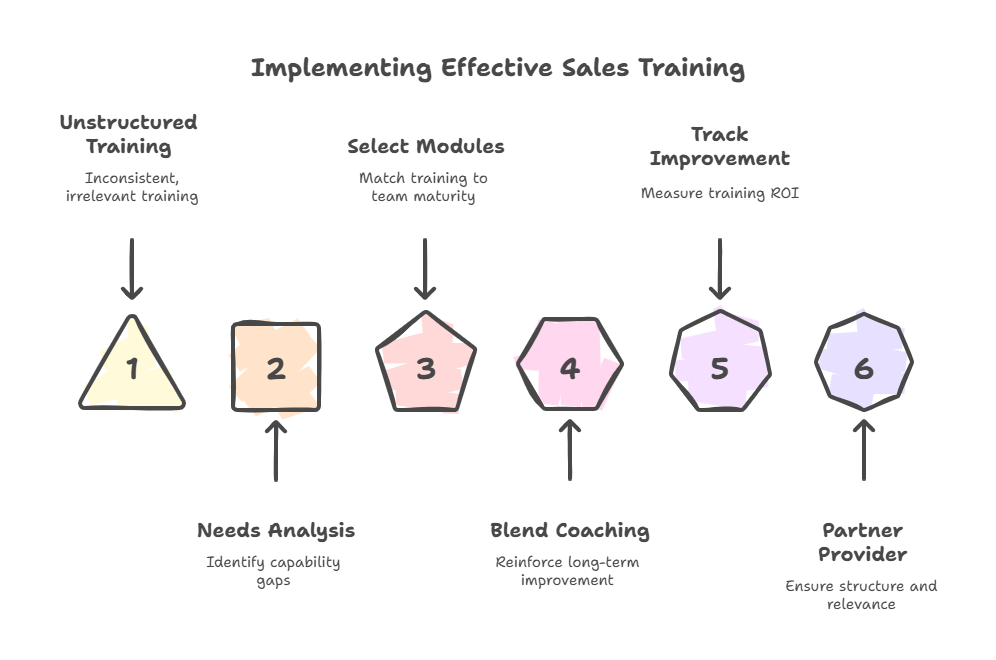
                                                  Implementing effective Sales Training

                                                  Implementing Effective Sales Training

                                                  Step 1 — Conduct a Sales Needs Analysis

                                                  Start by identifying capability gaps and performance bottlenecks across the sales funnel.

                                                  Actionable steps:

                                                  • Review CRM data to spot where deals drop off.
                                                  • Interview sales managers about team challenges.
                                                  • Observe live or recorded sales calls.
                                                  • Compare skill gaps against your sales competency framework.

                                                  Step 2 — Select the Right Training Modules

                                                  Training should match the maturity level of your sales force, as not every team needs advanced techniques immediately. Choose modules based on needs, such as:

                                                  • Foundational selling skills.
                                                  • Solution/consultative selling.
                                                  • Negotiation and closing.
                                                  • Key account management.
                                                  • Digital & social selling.

                                                  Step 3 — Blend Training With Coaching for Real Behaviour Change

                                                  Workshops lay the foundation, but coaching reinforces long-term improvement. Effective implementation includes:

                                                  • On-the-job coaching sessions.
                                                  • Manager-led deal reviews.
                                                  • Pipeline walkthroughs with structured feedback.
                                                  • Shadowing and role-play simulations.

                                                  Step 4 — Track Improvement Using Data & KPIs

                                                  Measurement is essential for proving training ROI. Track metrics such as:

                                                  • Lead-to-customer conversion rates.
                                                  • Win/loss ratio.
                                                  • Deal velocity.
                                                  • Average deal size.
                                                  • Customer retention and upsell success.

                                                  Step 5 — Partner With a Credible Training Provider

                                                  The right provider ensures structure, relevance, and consistent delivery. 

                                                  Thriving Talents — winner of two Gold Awards at the HR Vendors of the Year 2025, including ‘Best Sales Training Provider’, offers industry-aligned programmes that blend practical frameworks with real-world application.

                                                  Also read: How to Choose the Right Corporate Training Provider

                                                        Conclusion

                                                        In Malaysia’s fast-changing business environment, structured sales training is a core driver of revenue growth, customer trust, and competitive advantage. 

                                                        As markets become more digital and buyers more informed, sales teams must level up with stronger communication, deeper customer understanding, and sharper closing skills. 

                                                        A well-designed sales training programme ensures your team is equipped with practical techniques, consistent behaviours, and the confidence to perform at a higher standard.

                                                        For Malaysian corporates, the opportunity is clear: invest in sales capability development today to secure stronger pipelines, higher conversions, and long-term customer relationships tomorrow.

                                                        Thriving Talents supports this transformation by delivering award-winning sales training that blends proven frameworks, experiential practice, and measurable outcomes. 

                                                        Ready to strengthen your sales force? Explore how Thriving Talents can accelerate your team’s performance with practical, industry-tested sales training programmes.

                                                              Categories: Resources