Key Takeaways
- AI is transforming how leaders make decisions, interpret data, and guide teams.
- Ethical AI use, bias awareness, and transparency are now core leadership responsibilities.
- Leaders must blend human judgement with AI-assisted insights, not rely on AI blindly.
- Data literacy and continuous learning are essential leadership skills in 2026 and beyond.
- Leadership development programmes must evolve to include AI literacy, governance, and human-centric decision-making.
- Organisations that adapt early will build more agile, responsible, and future-ready leaders.
Introduction: AI Is Redefining How Leaders Make Decisions
Artificial intelligence is rapidly changing how organisations analyse data, solve problems, and make decisions. What once took teams hours or days can now be processed in seconds with AI tools.
Because of this shift, leadership must evolve. The speed, volume, and complexity of information that leaders handle today demand new mindsets, new tools, and stronger governance.
AI is a powerful asset, but only when used responsibly. Leaders need to understand what AI can do, where its limits are, and how to blend human judgement with machine intelligence. The leaders who adapt will guide their organisations forward; those who resist risk being left behind.

Why Leadership Must Change in the Age of AI?
AI is transforming how decisions are made, how teams operate, and how leaders guide organisations. Traditional leadership models that are built on intuition, experience, and hierarchical decision-making are no longer enough.
Today’s leaders must combine human judgement with AI-powered insights.
That means understanding the data behind decisions, questioning AI recommendations, and ensuring choices remain fair and transparent.
The shift is clear:
From: decisions based mainly on instinct and past experience.
To: decisions driven by evidence, analysis, and accountable processes.
Leaders who adapt to this new model make faster, clearer, and more consistent decisions, which is a critical advantage in an AI-enabled business environment.
Also read: Why AI in Corporate Training Is the Next Big Shift for HR & L&D Teams
Ethical AI, Bias & Trust — The New Leadership Imperatives
Leaders Must Understand AI Bias
AI systems learn from data — and that data can contain biases. If leaders rely blindly on AI outputs, they risk making unfair or inaccurate decisions. Examples of where bias can appear:
- Hiring recommendations.
- Performance scoring.
- Resource allocation or promotions.
Leaders must learn to question AI results, validate assumptions, and ensure every AI-supported decision remains fair and defensible.
Building Trust Through Responsible AI Use
Trust is essential for AI adoption in any organisation. Leaders must ensure:
- Transparency: Teams understand how AI tools generate recommendations.
- Privacy protection: Employee data is handled carefully and securely.
- Fairness: AI-driven decisions must be explainable, not mysterious “black-box” outputs.
When employees trust the system, they engage with it, and the organisation benefits.
Governance Is Now a Leadership Skill
AI governance is no longer an IT function; it is a leadership responsibility. Leaders must:
- Set clear policies for AI usage.
- Define review and approval processes.
- Establish checkpoints for ethical and compliant decision-making.
This governance ensures AI is used responsibly, consistently, and in alignment with organisational values.
How Decision-Making Is Changing With AI?
AI is reshaping how leaders gather information, evaluate options, and respond to challenges.
Instead of relying solely on intuition or past experience, leaders now have access to real-time insights and predictive analytics.
This shift is pushing decision-making to become faster, more structured, and evidence-driven.
Data-Driven Decision Making Becomes Standard
AI makes it easier for leaders to see patterns, trends, and risks that were previously hidden. But leaders must go beyond reading dashboards. They need to interpret data accurately and connect insights to business goals.
Key shifts include:
- Faster access to insights.
- More accurate forecasting.
- Evidence-based decisions replacing gut instinct.
Data becomes a strategic asset only when leaders know how to use it.
AI as a Decision Support Tool — Not a Replacement
AI strengthens decision-making by handling:
- Scenario analysis.
- Risk modelling.
- Summaries of large datasets.
- Trend predictions.
But the final decision still sits with the leader. AI cannot replace judgement, context, empathy, or values. The winning formula is AI-assisted, human-led decision-making.
Better Decisions Through Structured Models
To make AI-supported decisions more consistent, leaders can adopt simple models such as:
Human + AI Review Loop
- AI generates insights or recommendations.
- Leader reviews, questions, and adds context.
- Leader makes the final call.
Data-to-Decision Workflow
- Collect.
- Analyse.
- Interpret.
- Act.
Ethical & Risk Filters
Before approving any AI-informed decision, leaders evaluate:
- Potential bias.
- Employee impact
- Transparency
- Compliance
Structured thinking ensures decisions remain fair, consistent, and accountable.
How Leadership Mindsets Must Evolve in the Age of AI?
AI is transforming how teams operate, so leadership thinking must evolve alongside the technology.
Leaders can no longer rely only on past experience or intuition. They must embrace data, experimentation, and continuous learning. The shift is not about becoming “technical,” but becoming more open, adaptive, and collaborative with AI-powered tools.
From Control to Collaboration With AI
Leaders must stop viewing AI as a threat or a replacement. Instead, they need to see it as a strategic partner that enhances decision-making and accelerates work. Great leaders encourage teams to test AI tools, experiment with workflows, and refine ideas through iteration.
From Experience-Driven to Evidence-Driven
Relying solely on intuition or past experience is no longer enough. AI provides data, trends, and predictive insights, and leaders must validate decisions using evidence, not assumptions.
From Static Skills to Continuous Learning
AI evolves fast, and leadership must evolve with it.
Modern leaders need ongoing upskilling in AI literacy, prompting, data interpretation, and digital thinking. A growth mindset becomes essential because leadership skills can no longer remain fixed.
How Leadership Development Programmes Should Adapt to AI?
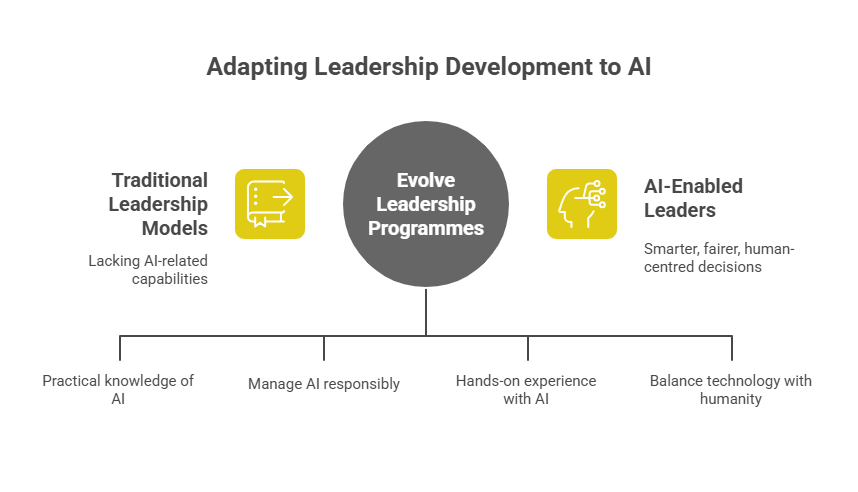
As AI reshapes how organisations operate, leadership development can no longer rely on traditional models. Leadership Development Programmes must evolve to equip leaders with the digital, ethical, and analytical capabilities required in an AI-enabled workplace.
Adapting Leadership Development to AI
The goal is simple: prepare leaders to make smarter, fairer, and more human-centred decisions in a technology-driven environment.
Include AI & Data Literacy as Core Modules
Leadership training must now go beyond communication and strategy. Leaders need practical knowledge of how AI works, its limitations, and how to interpret AI-generated insights. This helps them make informed, responsible decisions.
Add Ethical Decision-Making and Governance Training
AI introduces new risks — bias, privacy issues, and fairness concerns. Leadership programmes should include case studies, real-world examples, and governance frameworks to help leaders manage AI responsibly.
Integrate AI Tools Into Leadership Simulations
Use AI-driven scenarios for crisis management, forecasting, and strategic planning. These simulations give leaders hands-on experience in using AI as part of their decision-making process.
Teach Leaders to Make Human-Centric Decisions
Even with advanced AI, leadership still requires empathy, communication, trust-building, and coaching. The best leaders balance technology with humanity, thereby ensuring decisions benefit people as much as performance.

Conclusion
Leadership in the age of AI demands more than technical awareness — it requires ethical judgement, data literacy, and the ability to balance technology with human insight.
AI will not replace leaders, but leaders who fail to evolve will struggle to remain effective in a fast-changing environment.
Organisations that invest in AI-ready leadership development today will build teams that make smarter decisions, innovate faster, and lead responsibly.
To help your leaders stay ahead, explore Thriving Talents’ AI-enhanced leadership development programmes designed for modern corporate needs.