Key Takeaways
- HRD Corp team building is claimable in 2026 when programs include structured learning outcomes, accredited trainers, and proper documentation.
- Activities must develop real skills such as communication, leadership, problem-solving, resilience, and collaboration — not just provide entertainment.
- Hybrid programmes (workshop + team building) offer higher claim success and stronger ROI due to measurable learning and practical application.
- Employers should plan for HRD Corp requirements like attendance thresholds, cost caps, and scheme selection (HCC or SLB) to avoid claim rejection.
- Thriving Talents delivers fully HRD Corp–compliant, outcome-driven team building with end-to-end support for smooth claim approval.
Introduction
Team building has become one of the most popular ways for Malaysian organisations to strengthen teamwork, improve communication, and boost performance.
But in recent years, HR teams are also looking for programs that are not only impactful, but also HRD Corp–claimable.
As we move into 2026, this becomes even more important. HRD Corp’s updated Allowable Cost Matrix (ACM) and stricter compliance requirements mean employers must choose programs that meet clear learning outcomes and follow proper documentation rules.
At the same time, companies are relying on team building more than ever to support culture, reduce friction, and align employees with business goals.
This makes HRD Corp–claimable team building a strategic advantage for organisations planning their training calendars for 2026.
Are Team Building Programs HRD Corp-Claimable in 2026?

Yes, team building programs are HRD Corp-claimable in 2026 as long as they follow the learning-based requirements set under the Allowable Cost Matrix (ACM 2025).
HRD Corp does not approve recreational or entertainment-only activities; programs must demonstrate real, measurable learning.
So, what makes a team building program HRD Corp-claimable?
To qualify under HRD Corp (HCC or SLB schemes), a team building program must include:
- Clear learning outcomes: e.g., communication, collaboration, leadership, EQ, problem-solving, decision-making
- Structured facilitation: Activities must be guided by a trainer, not free-play or leisure activities
- Measurable learning components: Pre/post assessments, reflection sessions, or skill application tasks
- Trainer accreditation (2025 requirements): Trainers must meet HRD Corp’s updated standards under the ACM
- Documentation aligned with the correct scheme: Claim codes, programme outline, attendance records, objectives, assessments
These criteria ensure that team building supports real workplace capability development, not just morale boosting.
All Thriving Talents team building programs are designed to meet these HRD Corp requirements and are therefore claimable under HCC and SLB.
What Types of Team Building Activities Are Claimable?
HRD Corp doesn’t look at the “theme” of a team building activity — it looks at the learning outcomes behind each exercise. Below is an easy-to-understand breakdown of the types of activities that typically qualify under ACM 2025, grouped by the core skills they develop.
These categories show why the activities are claimable, not just what they are.
Mindset & Breakthrough Activities
(Example: Firewalk, Karate Board Breaking, Ice Bath, Arrow Breaking)
Skills Developed:
- Resilience
- Self-belief
- Emotional regulation
- Stress management
These activities focus on mindset shifts and overcoming limiting beliefs — a key competency in leadership and team performance.
Strategic Thinking & Problem-Solving Activities
(Example: Crack The Code, Trading Nation, Mega Puzzle, Box Factory)
Skills Developed:
- Analytical thinking
- Communication under pressure
- Team decision-making
- Resource management
These programs require teams to plan, analyse information, manage constraints, and solve challenges within time limits.
Collaboration & Communication-Based Activities
(Example: Paper Planes of Hope, River of Life, Railway Runway, DOPE Personality Test)
Skills Developed:
- Empathy
- Relationship-building
- Communication & active listening
- Cross-team collaboration
These sessions help teams strengthen trust, understand diverse personalities, and build stronger interpersonal dynamics.
Leadership & Delegation Activities
(Example: Formula 1 Build & Race, The Flagmaster, String Art, Team Relay Challenges)
Skills Developed:
- Leadership
- Delegation
- Coordination
- Time management
Participants take on rotating leadership roles, assign responsibilities, and execute tasks as a coordinated unit.
Creativity & Innovation Activities
(Example: Kitchen Showdown, TikTok Challenge, Fashion Gala, Invention Relay)
Skills Developed:
- Creative thinking
- Adaptability
- Innovation
- Rapid idea generation
These activities stretch participants to think outside the box and respond creatively to changing challenges.
Note: All these categories align with HRD Corp’s required learning outcomes under ACM 2025 — making them fully claimable for 2026 when documentation and facilitation standards are met.
Also read: HRDF Claimable Training & Courses: Guidelines & Procedures
How HRD Corp Claiming Works for Team Building Programs (2026 Guide)

Team building is HRD Corp–claimable in 2026 as long as the programme follows ACM 2025 rules. Here’s how the claiming process generally works and what employers need to prepare.
- Learning Outcomes Must Be Clear: HRD Corp approves team building only when the training has measurable learning outcomes, such as:
- Communication
- Collaboration
- Leadership
- Problem-solving
- Emotional intelligenceEvery activity must link back to a specific skill—not just “fun games.”
- Attendance Requirements Matter: Depending on the programme, HRD Corp requires 80%–100% attendance for claims to be approved.
- If participants do not show up, the claim amount may be reduced.
- Participant substitutions must be documented properly.
- Cost Limits Follow ACM 2025 Rules: Top-up fees may apply if costs exceed HRD Corp’s allowable limits. Factors include:
- Venue pricing
- Number of participants
- Special facilitators or “star trainers”
- Equipment-based activities (e.g., firewalk setup, ice bath, breakout tools)Each element must stay within HRD Corp’s published cost caps.
- Documentation Must Match ACM 2025: The following are required for smooth claim approval:
- Pre- and post-assessments
- Clear learning objectives
- Trainer accreditation (following 2025 standards)
- Claim codes that match the scheme chosen (HCC or SLB)
- Attendance records and programme agendaNote: Improper documentation is one of the top reasons for rejection.
Also read: HRD Corp 2025 Update: What Employers Should Know About the New HCC & SLB Schemes
The Hybrid Model: Why Most 2026 Programs Combine Workshops + Team Building
Since 2024–2025, HRD Corp has increasingly emphasised learning-based outcomes—not just activities. That’s why most claimable programs in 2026 follow a hybrid model that blends workshops with experiential team building.
Here’s why hybrid programs work better:
- Workshops Teach the Concepts: Participants first learn practical skills such as:
- Emotional intelligence
- Communication and feedback
- Leadership and delegation
- Conflict management
- Collaboration frameworks
This establishes the foundation HRD Corp expects under ACM 2025.
- Team Building Activities Reinforce the Skills: After the workshop, teams immediately practise what they learned through structured activities. Examples:
- If the workshop teaches feedback skills, an activity may include a feedback quiz challenge.
- If the workshop covers leadership styles, an activity may require delegating tasks under time pressure.
- Better Claim Approval Under HRD Corp: Hybrid programs clearly match HRD Corp’s required outcomes:
- Theory + practice
- Measurable behavioural change
- Demonstrated application
This increases the likelihood of a smooth claim submission.
- Higher ROI for Employers: The hybrid design ensures employees don’t just “have fun” but return with:
- Stronger teamwork
- Clearer communication habits
- Better leadership readiness
- Higher engagement and morale
Strategic Team Building Demand Cycle (Based on Corporate Patterns)
Most Malaysian companies follow a predictable rhythm when planning their team building and training programs.
Understanding these cycles helps HR teams plan levy usage better and choose the right type of program for each quarter.
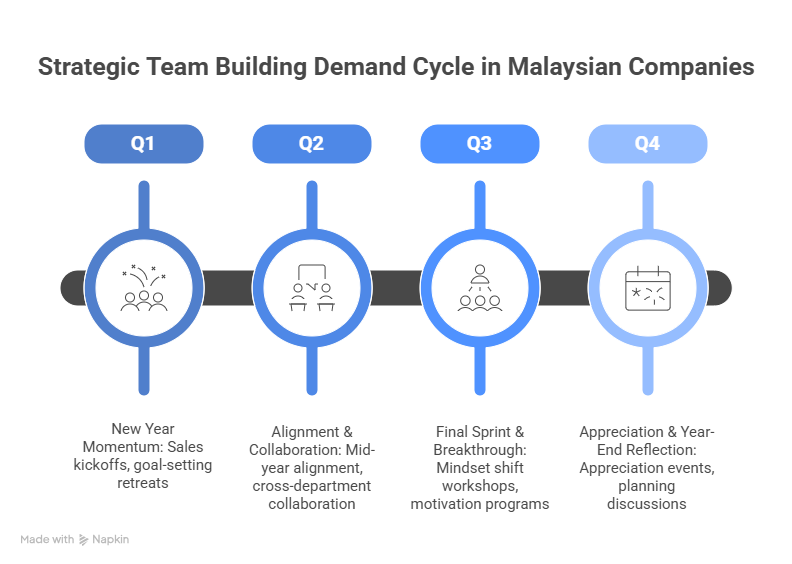
Image: Team Building Demand Cycle, Malaysia
Q1 — New Year Momentum
Kickstart the year with energy and alignment. Common needs:
- Sales kickoffs
- Goal-setting retreats
- High-energy mindset sessions
- Re-establishing team spirit after the year-end break
Q2 — Alignment & Collaboration
Focus shifts to improving teamwork and removing performance blockers. Common needs:
- Mid-year alignment
- Cross-department collaboration
- Communication and conflict management
- Identifying roadblocks to hit mid-year targets
Q3 — Final Sprint & Breakthrough
Teams prepare for the “last mile” push toward annual KPIs. Common needs:
- Mindset shift workshops
- Breakthrough activities
- Motivation and resilience programs
- Strategy refinement for Q4 goals
Q4 — Appreciation & Year-End Reflection
A time for recognition, bonding, and planning for the next year. Common needs:
- Appreciation events
- Team reflection sessions
- Bonding activities
- Planning discussions for the following year
ROI: What Employers Can Expect From HRD Corp–Claimable Team Building
HRD Corp–claimable team building is about improving how people work together. When designed with measurable learning outcomes, these programmes deliver real business impact.
Here’s what employers can expect in 2026:
- Stronger communication and fewer conflicts: Teams learn how to share information clearly, give feedback, and understand each other better.
- Improved collaboration across departments: Activities break silos and build trust, helping teams solve problems faster as a group.
- Higher psychological safety: Employees feel more confident speaking up, contributing ideas, and raising issues, which improves innovation and decision-making.
- Better morale and retention: When employees feel appreciated and connected, engagement rises and turnover decreases.
- Real skill application through practice: Pre- and post-assessments track improvements in communication, leadership, decision-making, and problem-solving.
- Better leadership readiness: Activities help identify high-potential employees and build future leaders through real, hands-on scenarios.
These outcomes make HRD Corp–claimable team building a strategic investment — not just an event.
How Thriving Talents Ensures Smooth HRD Corp Claim Approval

HRD Corp claims can be overwhelming for many HR teams, especially with stricter ACM 2025 requirements.
Thriving Talents helps simplify the entire process so employers can focus on the training impact rather than paperwork.
Here’s how we make claim approval smooth and hassle-free:
- Fully HRD Corp–Registered & ACM 2025 Compliant: All team building programs and trainers meet the latest HRD Corp accreditation and cost matrix guidelines.
- Clear, HRD-Friendly Learning Outcomes: Every workshop and team-building module is mapped to competencies such as communication, collaboration, leadership, and problem-solving, exactly what HRD Corp requires for claimability.
- Pre- & Post-Training Assessments Included: These assessments provide measurable outcomes and strengthen claim submissions.
- Hybrid Program Design for Better Approval: Workshops deliver the theory; team building activities provide practical application, which is a combination HRD Corp strongly favours.
- End-to-End Documentation Support: From claim codes to attendance templates, evaluation forms, and submission checklists, we prepare everything HR needs.
- Experience with Both HCC & SLB Schemes: We guide HR teams on which scheme fits best based on the company’s objectives, budget, and training structure.
- Proactive Claim Risk Management: We help prevent common issues like attendance gaps, wrong scheme selection, or documentation mismatches.
With Thriving Talents, HR teams get peace of mind knowing their team-building program is fully aligned with HRD Corp’s latest rules, and is claim-ready.
Also read: How to Maximise Your HRD Corp Levy with Strategic Team Building Programs
Conclusion
Team building in 2026 is no longer about fun activities alone. HRD Corp is placing a stronger emphasis on structured learning, clear outcomes, and proper documentation. That means companies need programs that develop real skills and meet HRD Corp’s ACM 2025 requirements.
With the right approach, HRD Corp–claimable team building becomes a powerful tool to strengthen teamwork, build leadership, improve communication, and reinforce a high-performance culture — all while maximising your levy.
Thriving Talents designs fully claimable, outcome-driven team building experiences that meet HRD Corp standards and deliver measurable impact for your organisation.
Ready to plan your HRD Corp–claimable team building for 2026? Book a consultation with Thriving Talents and we’ll help you design the right programme for your team.