
- Common Sales Mistakes Companies Make
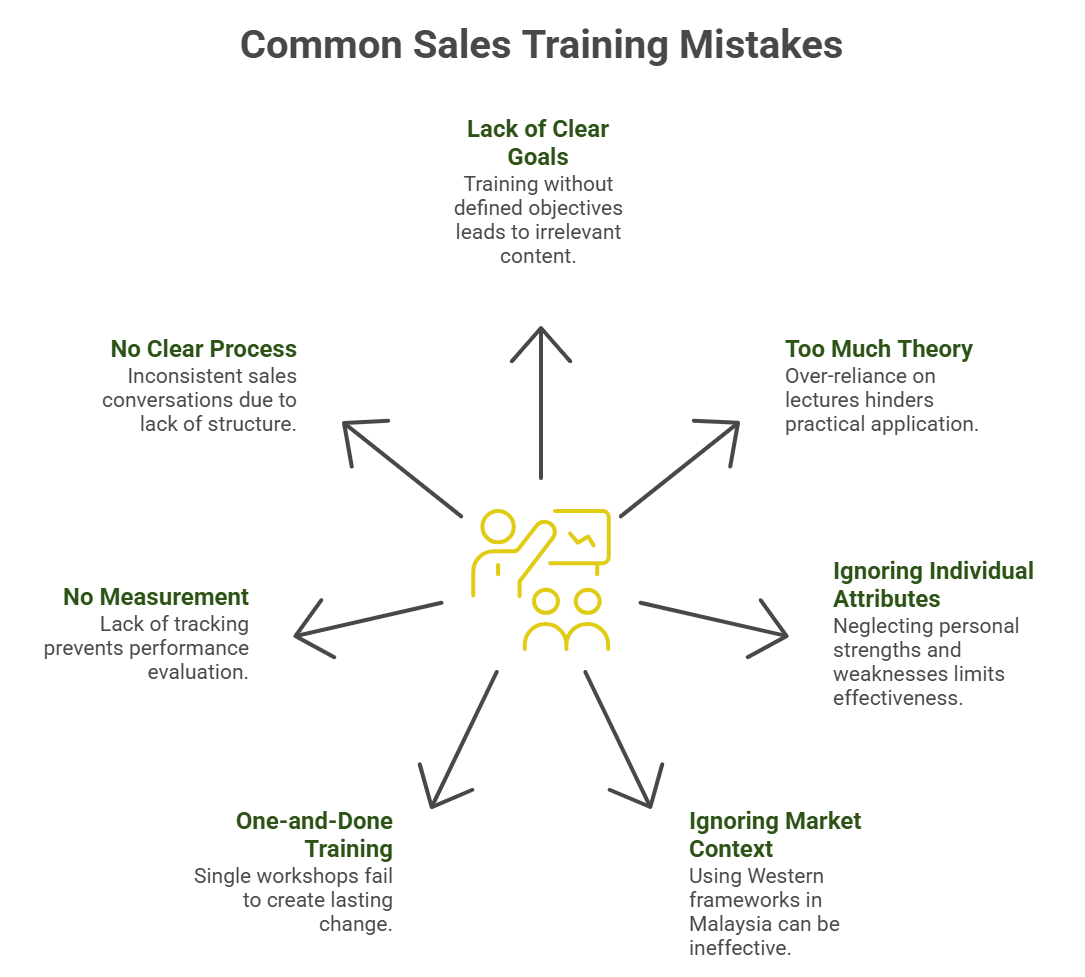
Here are seven common sales training mistakes that often prevent organisations from achieving long-term improvements in sales performance, customer engagement, and team capability.
Mistake #1: Starting Sales Training Without Clear Goals or Skill Gap Analysis
Many companies begin training without identifying the actual business outcomes they want to achieve. Training objectives are often based on assumptions rather than real sales performance data.
This creates programmes that focus on the wrong skills and fail to address actual capability gaps.
How Effective Sales Training Starts
Effective sales training should begin with capability assessments that identify communication weaknesses, objection-handling challenges, sales process gaps, and customer engagement issues. This creates more targeted and relevant learning outcomes.
Also read: How to Conduct a Sales Training Needs Assessment for Your Business.
Mistake #2: Too Much Theory, Not Enough Practice
Many sales workshops rely heavily on slides, lectures, and frameworks. However, sales skills improve through application rather than passive learning.
Participants may remember concepts temporarily but struggle to apply them during real customer conversations. Without practice, retention levels remain low.
How Practical Learning Improves Sales Skills
Modern sales training should include role-plays, simulations, objection-handling exercises, and real customer scenarios. Hands-on activities should ideally make up most of the learning experience to improve confidence and behavioural application.
Mistake #3: Ignoring Individual Sales Attributes
Sales training often focuses only on techniques and processes. However, not every salesperson has the same mindset, motivation, or behavioural strengths.
Some employees may struggle despite receiving the same training because strong sales performance also depends on attributes such as confidence, resilience, communication style, and willingness to learn.
How Effective Sales Development Should Work
Effective sales development should assess both technical skills and behavioural traits. This helps organisations understand who can perform, who is likely to improve, and how coaching can be tailored more effectively.
Mistake #4: Ignoring Malaysian Market Context
Many sales frameworks are designed for Western markets and may not fit Malaysian business culture.
In Malaysia, buyers often value trust-building, respectful communication, relationship development, and long-term engagement. Aggressive or overly transactional sales approaches may damage customer relationships instead of strengthening them.
Why Localised Sales Training Works Better
Training that reflects Malaysian buyer behaviour, multicultural communication styles, and industry-specific selling situations helps sales teams build stronger trust and more meaningful customer relationships.
Also read: Relationship Selling: Why Trust Beats Tactics Every Time.
Mistake #5: One-and-Done Training Events
Many organisations treat sales training as a single workshop instead of an ongoing learning process.
Without reinforcement, participants often return to old habits within a few weeks after training. Learning retention drops significantly when there is no follow-up support.
How Continuous Learning Improves Retention
Blended learning approaches that include post-training coaching, microlearning, reinforcement exercises, and manager follow-ups help sales teams apply skills more consistently over time.
Mistake #6: No Measurement or Follow-Up
Many companies evaluate training only through attendance records or participant feedback forms. However, positive feedback does not always translate into improved sales performance.
Without proper measurement, organisations cannot determine whether training improved behaviour, communication quality, or business outcomes.
What Companies Should Measure After Training
Effective sales training should track metrics such as conversion rates, sales activity, customer engagement quality, behavioural application, and sales cycle improvements. Results should ideally be monitored for three to six months after training.
Also read: Sales Training ROI: What Malaysian Business Leaders Need to Measure.
Mistake #7: Failing to Establish a Clear Sales Process
Some organisations train sales teams without providing a structured sales process or methodology to follow.
As a result, sales conversations become inconsistent, and employees rely on personal habits instead of proven selling frameworks. Best practices are rarely repeated across the organisation, and training knowledge fades quickly after workshops.
How Effective Sales Training Creates Consistency
Standardising prospecting approaches, qualification methods, objection handling, follow-up strategies, and closing techniques helps sales teams communicate more consistently and move opportunities through the pipeline more effectively.