
Key takeaways:
- Modern sales training focuses on practical skill development, real-world application, and measurable performance improvement.
- A structured framework helps organisations move beyond one-off workshops to a consistent and results-driven sales training implementation process.
- The four key stages of a modern sales training framework are UNDERSTAND, PROFILE, DEPLOY, and MEASURE.
- Conducting a pre-training needs assessment ensures training addresses real capability gaps and aligns with business priorities.
- Customised training programmes improve relevance by reflecting the organisation’s industry, market, and customer expectations.
- Experiential sales training methods such as simulations and role-play help teams practise and apply skills effectively.
- Thriving Talents designs modern sales training programmes using this structured framework, helping organisations improve sales capability, drive behavioural change, and achieve measurable performance results.
Introduction
Sales training has evolved significantly in recent years.
Many companies still rely on one-off workshops or motivational sessions that create short-term enthusiasm but deliver little long-term impact. Teams may feel energised after training, but without structure, those improvements rarely last.
In fact, as of 2026, 72% of sales leaders say training fails because it is too generic or one-size-fits-all, highlighting a common gap between training design and real business needs.
Modern sales training takes a different approach. It focuses on practical skill development, real customer scenarios, and measurable performance improvement.
To achieve lasting results, organisations need more than good content. They need a structured approach that connects training directly to business outcomes.
A clear, step-by-step modern sales training framework helps ensure that training strengthens both sales capability and performance over time.
What is Modern Sales Training?
At its core, modern sales training is about building practical selling capability, not just delivering knowledge.
Rather than passively absorbing concepts, participants actively practise real sales conversations, analyse customer scenarios, and receive structured feedback.
Learning is also tied to measurable business metrics such as conversion rates, deal quality, and
This ensures that new skills are not just understood, but applied in ways that improve real sales outcomes.
How Do Companies Implement Modern Sales Training?
In high-performing organisations, training is not treated as a one-off activity but as a structured process.
A typical implementation follows a four-step framework that connects learning with business results.
These stages include diagnosing sales capability gaps, designing customised programmes, delivering experiential learning, and measuring performance outcomes.
By following this approach, organisations ensure that training remains aligned with real performance challenges and business goals.
What are the key components of a modern sales training framework?
A modern sales training framework is built around four key stages:
- UNDERSTAND (needs assessment)
- PROFILE (programme design)
- DEPLOY (experiential training)
- MEASURE (performance tracking)
Each stage playxperiential learning, customisation, and ROI measurement. Sales teams practise real scenarios, apply new skills, and track improvements over time.
This structure ensures that training translates into meaningful improvements in sales performance, not just short-term knowledge gain.
Also read: Traditional vs Modern Sales Training Methods: Which Works Better in Malaysia?
Step-by-Step Framework to Implement Modern Sales Training
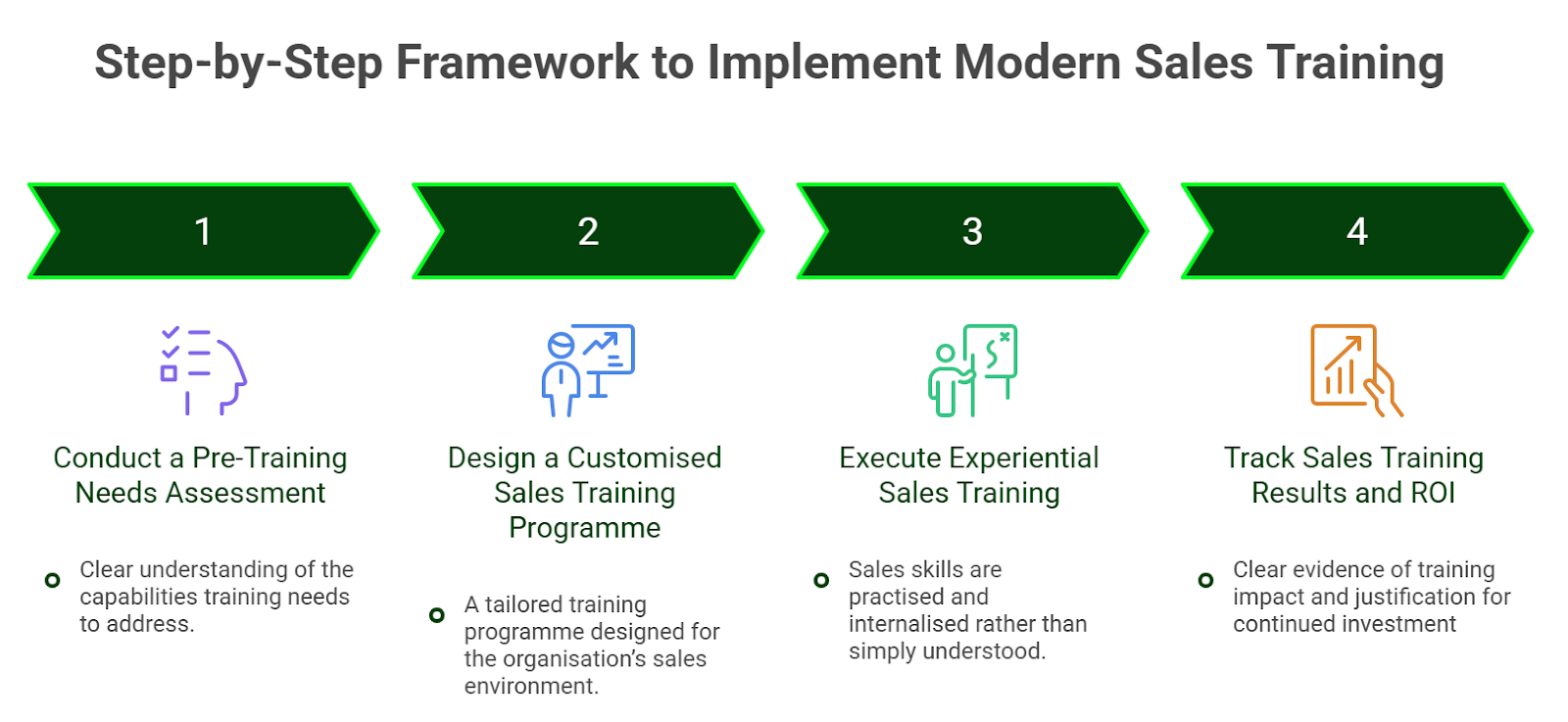
Image: The 4-step framework for modern sales training implementation
Implementing modern sales training requires more than delivering workshops. It involves a structured, end-to-end process that builds capability over time and aligns closely with business goals.
Step 1 – UNDERSTAND: Conduct a Pre-Training Needs Assessment
Before designing any training programme, organisations need a clear picture of their current sales performance and challenges. This step sets the foundation for everything that follows.
What Should Companies Do Before Sales Training Begins?
Effective sales capability development begins with understanding current challenges.
Without this step, training risks addressing the wrong problems or delivering content that is not relevant.
A structured needs assessment helps leaders identify capability gaps and align training with business priorities.
Key actions include:
- Interviewing sales managers and top performers
- Reviewing current sales performance data
- Identifying specific skill gaps across the team
- Understanding Malaysian market challenges affecting sales
- Mapping buyer personas and the existing sales process
Tools Used in the Assessment Stage
- Sales performance metrics such as conversion rates and deal size
- Customer feedback and lost deal analysis
- Skills assessment surveys
- Competitive market analysis
Outcome: Clear understanding of the capabilities training needs to address.
Timeline: Typically conducted 2–4 weeks before training begins.
Also read: How to Conduct a Sales Training Needs Assessment for Your Business?
Step 2 – PROFILE: Design a Customised Sales Training Programme
Once capability gaps are clearly identified, the next step is to translate those insights into a structured and relevant training programme.
Why Is Customisation Important in Modern Sales Training?
Generic programmes rarely address the real challenges sales teams face.
Customisation ensures that training reflects the organisation’s industry, products, and customer expectations. This makes learning more relevant and easier to apply in day-to-day sales situations.
In markets like Malaysia, where relationships and trust are critical, the local context becomes even more important.
What Happens During Training Design?
The training design stage turns insights into a practical learning experience.
- Conduct individual seller capability assessments.
- Analyse team dynamics and learning styles.
- Develop Malaysian market-specific sales scenarios.
- Create industry-relevant case studies.
- Select appropriate modern sales training methods.
Tools Used During Programme Design
Organisations use a combination of data, feedback, and analysis tools to build a clear picture of current sales performance.
- Sales performance metrics such as conversion rates and average deal size provide a quantitative view of how the team is performing and where gaps may exist.
- Customer feedback and lost deal analysis offer insight into why opportunities are won or lost, helping identify patterns in buyer behaviour and sales approach.
- Skills assessment surveys evaluate individual and team capabilities, highlighting specific areas where training is needed.
- Competitive market analysis helps organisations understand external factors, including market trends and competitor strategies that may impact sales performance.
Outcome: A tailored training programme designed for the organisation’s sales environment.
Timeline: Usually 2–3 weeks after the initial assessment.
Step 3 – DEPLOY: Execute Experiential Sales Training
With the programme designed, the focus shifts to delivering training in a way that builds real skills, not just knowledge.
Sales capability improves when teams actively practise, receive feedback, and refine their approach in realistic situations.
As of 2026, studies show that organisations implementing structured training programmes can achieve up to a 57% increase in sales effectiveness, reinforcing the importance of how training is delivered.
What Happens During Experiential Sales Training?
Experiential sales training focuses on active participation, allowing sales teams to practise and refine skills in realistic situations.
- Interactive workshops instead of lecture-based sessions.
- Business simulations and role-playing exercises.
- Practice using real customer scenarios.
- Video review and peer feedback sessions.
- Practical frameworks ans
- Role-playing exercised tools for everyday selling.
Training Methods Commonly Used
To support this learning approach, organisations typically use a mix of:
- Business simulations
- Group problem-solving activities
- Digital selling practice
- Real-time coaching
Outcome: Sales skills are practised and internalised rather than simply understood.
Timeline: Typically delivered through 2–3 day workshops with ongoing reinforcement.
Step 4 – MEASURE: Track Sales Training Results and ROI
After training is delivered, the focus shifts to evaluating its impact on both behaviour and business performance.
Measurement ensures that training is not just completed, but translated into meaningful results.
Why Measurement Is Critical?
Training should be evaluated based on outcomes, not just participation.
Without structured measurement, organisations cannot determine whether training has improved performance or contributed to growth.
It also provides valuable insights that help refine future training initiatives.
What Should Companies Track After Sales Training?
To understand whether training is being applied effectively, organisations should track both behavioural and capability changes.
- Behavioural changes in sales conversations.
- Improvements in sales activity levels.
- Post-training capability assessments.
- Feedback from participants and managers.
Key Metrics Leaders Should Track
To evaluate business impact, leaders should focus on performance metrics that reflect real sales outcomes.
- Sales revenue growth
- Conversion rate improvement
- Average deal size increase
- Reduction in sales cycle length
- Customer satisfaction scores
- Skills application rates
Outcome: Clear evidence of training impact and justification for continued investment
Timeline: Typically evaluated 3–6 months after training
Also read: Sales Training ROI: What Malaysian Business Leaders Need to Measure.
Why a Structured Sales Training Framework Works Better

A structured framework ensures that training starts with diagnosing real problems rather than applying generic solutions.
Experiential learning allows sales teams to practise skills in realistic scenarios, making them easier to apply in actual customer interactions.
Measurement connects training outcomes with business results, providing clarity on impact and guiding future improvements.
Together, these elements create sustainable improvements in sales capability and long-term performance.
Also read: 5 Business Problems Modern Sales Training Solves.
Designing Sales Training That Drives Real Results
Effective sales training begins with understanding real business challenges.
High-impact programmes focus on diagnosing capability gaps before designing solutions. Learning is then tailored to the organisation’s market, customer expectations, and sales environment.These programmes combine experiential workshops, practical simulations, and structured reinforcement to ensure skills are applied consistently. The focus remains on behavioural change rather than theory alone.
Leading organisations treat sales training as a continuous capability-building journey.
At Thriving Talents, programmes are designed around these principles, using experiential learning and immersive simulations such as BLUEPRINT to help organisations translate training into measurable sales performance improvement.
Conclusion
Modern sales training focuses on developing practical selling capability rather than delivering theoretical knowledge.
A structured framework that includes diagnosing needs, designing customised programmes, delivering experiential learning, and measuring results helps organisations achieve lasting improvements in sales performance.
As a double Gold Award winner at the HR Vendors of the Year 2025, Thriving Talents designs sales development programmes that turn insights into action, helping businesses close capability gaps, strengthen sales performance, and achieve sustainable results.
Looking to implement a structured, modern sales training framework for your team? Explore our training and workshops here.