
Key takeaways:
- Modern sales training focuses on solving real business challenges such as low sales performance, inconsistent results, and weak customer engagement.
- Traditional sales training often fails due to over-reliance on theory, lack of practice, and minimal reinforcement after workshops.
- Experiential sales training improves performance through role-plays, simulations, and real-world applications that drive behavioural change.
- Customised sales training in Malaysia is essential to reflect relationship-driven selling, cultural nuances, and local market dynamics.
- Measuring sales training ROI requires linking learning outcomes to business metrics such as conversion rates, deal quality, and pipeline performance.
- Digital and frontline sales skills training help teams adapt to modern buyers and uncover more revenue opportunities.
- Thriving Talents designs sales training programmes that focus on practical application, behavioural change, and measurable improvements in sales team performance.
Introduction
Sales training is often treated as a way to motivate teams or introduce new techniques. But for many organisations, the real challenge isn’t a lack of training, it’s a lack of results.
Sales teams still struggle with inconsistent performance, low conversion rates, and weak customer engagement. Deals stall. Opportunities are missed. And despite repeated training efforts, the same issues keep resurfacing.
The root problem? Most training focuses on what salespeople know, not how they sell.
This is where modern sales training makes a difference. Instead of relying on theory, it focuses on experiential learning, real-world application, and measurable outcomes.
When done right, it doesn’t just improve knowledge; it solves real sales training problems, strengthens behaviour, and drives sustainable sales performance improvement.
Why Traditional Sales Training Often Fails?
Traditional sales training often looks good on paper, but falls short in practice.
Many programmes rely heavily on presentations, frameworks, and one-way learning. Participants leave with new ideas, but little confidence in applying them.
Without structured practice, it becomes difficult to turn concepts into meaningful conversations. Over time, and without reinforcement, these ideas fade once salespeople return to their daily routines.
In 2026, statistics show that individuals can forget up to 80 to 90% of what they learned within 90 days of training. This highlights a key issue. Learning that is not applied consistently rarely translates into lasting performance improvement.
Relevance is another challenge. Generic training often fails to reflect actual customer interactions, especially in relationship-driven markets like Malaysia.
As a result, there is often a disconnect between what is taught and what happens in real sales environments.
Modern sales training addresses this by focusing on practical application, contextual learning, and measurable behavioural change.
Also read: Traditional vs Modern Sales Training Methods: Which Works Better in Malaysia?
5 Business Problems Modern Sales Training Solves
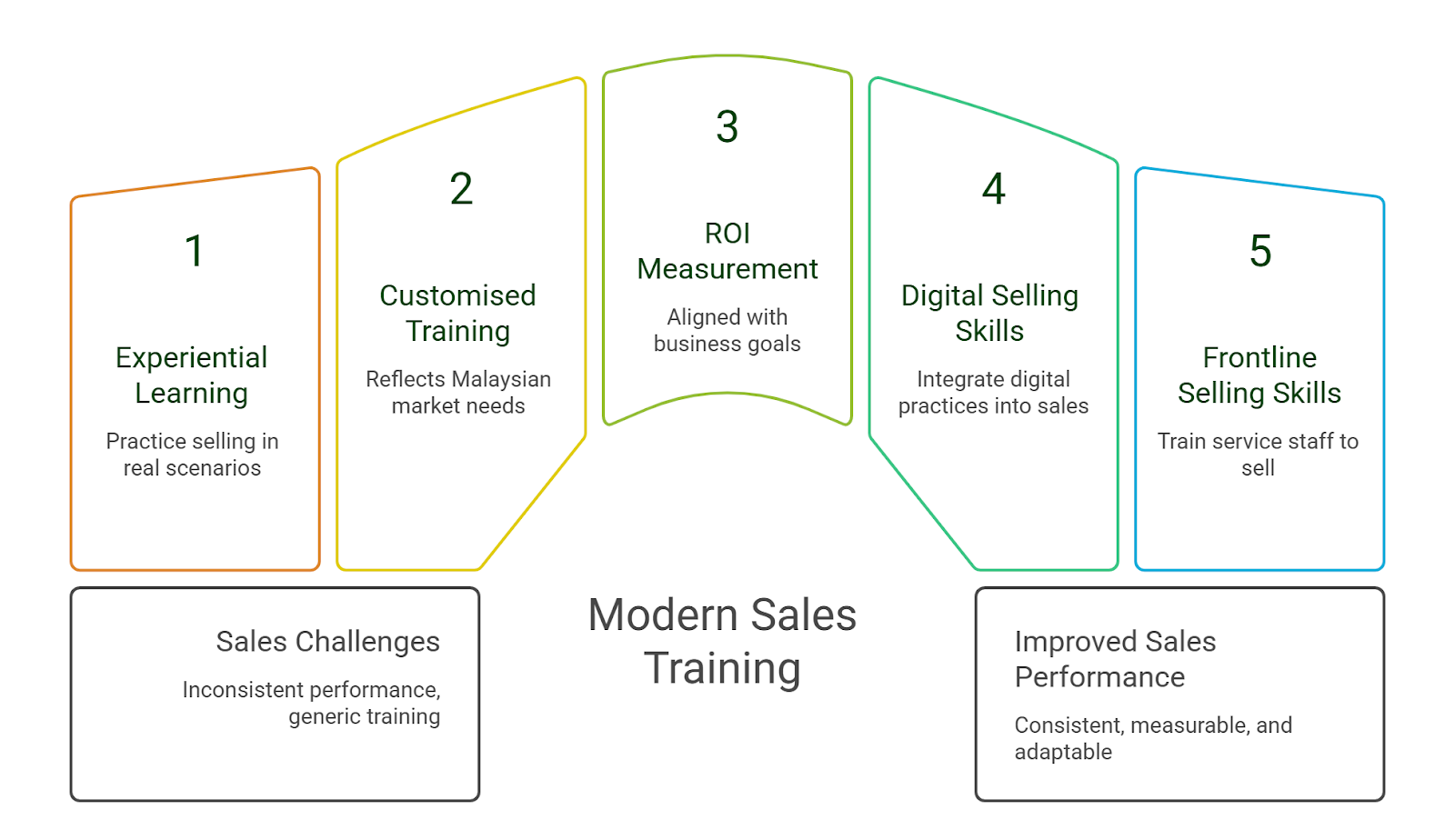
Image: Business challenges that modern sales training solves
Let’s explore the most common sales challenges organisations face and how modern sales training addresses them.
Problem #1: Low Sales Team Performance
Many organisations do not lack effort. They lack consistency.
Sales teams may have strong individuals, but overall sales team performance remains uneven. Some reps perform well, while others struggle with:
- Handling objections confidently
- Moving deals forward
- Closing effectively
- Adapting to different customer types
Over time, this inconsistency affects pipeline quality, team morale, and revenue predictability.
Why Traditional Sales Training Does Not Improve Performance?
Traditional programmes often rely on theory instead of practical application.
Salespeople listen to concepts and frameworks but rarely practise real conversations with customers.
Without reinforcement, participants return to old habits after the training ends. As a result, the programme has little long-term impact on behaviour or results.
How Modern Sales Training Improves Sales Performance?
Modern experiential sales training focuses on behaviour change rather than knowledge transfer.
Instead of passive learning, participants actively practise selling.
- Experiential learning activities: Participants practise through role-plays, case exercises, and real sales scenarios.
- Business simulations: Teams practise decision-making through immersive simulations such as BLUEPRINT, allowing them to experiment with strategies and outcomes.
- Blended reinforcement: Post-workshop learning helps participants apply skills in real sales situations.
- Behavioural tracking: Pre- and post-training assessments measure improvements in sales conversations and behaviours.
This approach significantly improves sales training effectiveness and supports long-term performance development.
Also read: How to Implement Modern Sales Training: Step-by-Step Framework
Problem #2: Generic Sales Training Doesn’t Fit the Malaysian Market
Many organisations adopt global sales frameworks without adapting them locally. But selling in Malaysia is different.
It is relationship-driven, culturally nuanced, and often built on trust over time. What works in Western markets does not always translate effectively.
As a result, salespeople may understand the framework but struggle to apply it in real conversations.
What Malaysian Sales Teams Actually Need
Effective sales training in Malaysia must reflect how business is actually done:
- Building trust before pushing for decisions
- Adapting communication styles across cultures
- Understanding different buyer expectations
- Managing long-term relationships, not just transactions
Without this context, training feels disconnected from reality.
How Customised Training Improves Results?
Modern programmes are designed around the organisation.
- Pre-training needs assessment: Organisations identify real capability gaps before training begins.
- Localised case scenarios: Training examples reflect Malaysian buyer behaviour and decision-making patterns.
- Industry-specific design: Content aligns with the organisation’s products, services, and markets.
- Relationship-first frameworks: Sales teams learn how to build trust and credibility before attempting to close deals.
This makes training immediately applicable and more effective.
Also read: Relationship Selling: Why Trust Beats Tactics Every Time.
Problem #3: Sales Training Without Measurable ROI
One of the biggest frustrations for leaders is simple. They invest in training but cannot clearly see the results.
Too often, training success is measured by attendance or feedback scores. While useful, these do not show business impact.
Without clear measurement, it becomes difficult to justify investment or improve future programmes.
As of 2026, research shows that organisations implementing structured and continuous modern training programmes can achieve returns exceeding 300%.
This is especially true when training is aligned with business goals and reinforced over time. Despite this potential, many companies still struggle to capture and demonstrate that value.
Why Training ROI Is Difficult to Measure?
Sales performance is influenced by many factors, making attribution challenging.
Revenue improvements take time. Behavioural changes are harder to track. Many organisations also lack a structured measurement approach.
As a result, the training impact remains unclear.
How Modern Training Supports ROI Measurement?
Modern programmes are designed with measurement in mind from the beginning.
- Baseline assessment: Sales performance metrics are measured before training begins.
- Sales KPI alignment: Learning objectives are linked to specific business goals, such as conversion rates or deal size.
- Behavioural tracking: Improvements in sales conversations and processes are monitored.
- Post-training evaluation: Results are reviewed against initial performance benchmarks to assess impact.
These methods improve transparency and help organisations understand the real value of sales training effectiveness.
Also read: Sales Training ROI: What Malaysian Business Leaders Need to Measure.
Problem #4: Sales Teams Struggle With Digital Selling
Today’s buyers are more informed than ever.
By the time they speak to a salesperson, they have already done their research, compared options, and formed initial opinions.
This changes the role of the salesperson and requires new skills.
However, many teams are still not equipped for digital engagement.
Common Digital Selling Challenges
- Sales teams often struggle with:
- LinkedIn prospecting and outreach
- Social selling strategies
- WhatsApp Business communication
- CRM pipeline visibility
- Virtual presentation skills
These gaps limit their ability to reach and engage modern buyers effectively.
How Modern Sales Training Builds Digital Selling Skills?
Modern programmes integrate digital selling practices into everyday sales activities.
- Digital prospecting techniques: Salespeople learn how to initiate conversations through platforms like LinkedIn.
- Multi-channel communication: Sales teams combine digital and face-to-face selling methods.
- CRM integration: Sales activities become more visible and structured through better CRM usage.
- Virtual presentation skills: Participants practise delivering persuasive online presentations and product demonstrations.
Developing these capabilities improves adaptability and strengthens overall sales team performance.
Problem #5: Service Staff Miss Sales Opportunities
In many organisations, frontline staff interact with customers more frequently than sales teams. Yet these interactions are often treated purely as service moments, not sales opportunities.
As a result, valuable opportunities to recommend solutions are missed.
How Frontline Selling Skills Improve Service Revenue?
With the right frontline sales skills training, service teams can contribute to revenue without compromising customer experience.
Key techniques include:
- Natural upselling frameworks: Staff learn how to recommend products confidently without appearing pushy.
- Call control techniques: Conversations are guided toward helpful solutions.
- Product knowledge development: Employees gain a deeper understanding of product value and benefits.
- Service-to-sales transitions: Staff practice introducing relevant solutions while maintaining positive customer experiences.
This approach helps service teams balance customer satisfaction with revenue generation.
Building Sales Training That Drives Real Results

Effective sales training starts with understanding real business challenges, not delivering generic content.
High-impact programmes focus on diagnosing sales capability gaps before designing solutions. Instead of one-size-fits-all approaches, learning journeys are tailored to the organisation’s market, customer expectations, and sales environment.
These programmes typically combine experiential workshops, practical simulations, and structured reinforcement to ensure skills are applied consistently. The emphasis is on real behavioural change, not just theory.
Leading organisations treat sales training as a continuous capability-building journey, not a one-off event.
At Thriving Talents, programmes are designed around these principles, using experiential learning and immersive simulations to help organisations translate training into measurable sales performance improvement.
FAQs
How does sales training improve sales performance?
Sales training improves performance by strengthening how salespeople engage, communicate, and close.
When training includes practical application, it builds confidence and consistency, leading to better results.
How long does it take to see results from sales training?
Results can vary depending on the organisation and training structure.
Behavioural improvements may appear within weeks if participants apply new skills immediately. However, measurable revenue improvements may take several months as sales cycles progress.
Programmes that include reinforcement and coaching typically produce faster and more sustainable results.
What skills should modern sales training include?
Modern programmes should include consultative selling, objection handling, relationship-building, digital prospecting, CRM usage, and virtual selling skills.
Is sales training worth the investment for companies?
Yes. When designed properly, it improves conversion rates, deal quality, and team consistency, making it a valuable investment.
What makes experiential learning effective for sales teams?
It focuses on practice. Salespeople engage in real scenarios, receive feedback, and build confidence, which improves sales training effectiveness.
How can sales training improve sales performance?
Sales training improves performance by strengthening skills across the entire sales process.
Participants learn how to identify customer needs, communicate value clearly, handle objections confidently, and close deals effectively.
When combined with reinforcement and coaching, these improvements translate into measurable sales performance improvement.
Can customer service staff be trained to sell?
Yes. With the right training, service staff can introduce solutions naturally during interactions while maintaining customer satisfaction.
Conclusion
Modern sales training focuses on solving real business challenges rather than delivering theory.
By emphasising experiential learning, customised programmes, and clear measurement, organisations can build stronger and more adaptable sales teams.
This leads to sustained sales performance improvement and better business outcomes.
As a double Gold Award winner at the HR Vendors of the Year 2025, Thriving Talents designs programmes that turn insight into action, helping organisations close capability gaps and achieve lasting results.
Struggling with inconsistent sales performance or low conversion rates? Discover how modern sales training can help you build a stronger, more capable sales team. Explore our solutions here.