
Key takeaways:
- Sales training is a long-term investment, and ROI should be measured through clear, performance-based metrics, not just attendance or feedback.
- Malaysian leaders are under growing pressure to justify training budgets, especially in high-value industries like wholesale and retail.
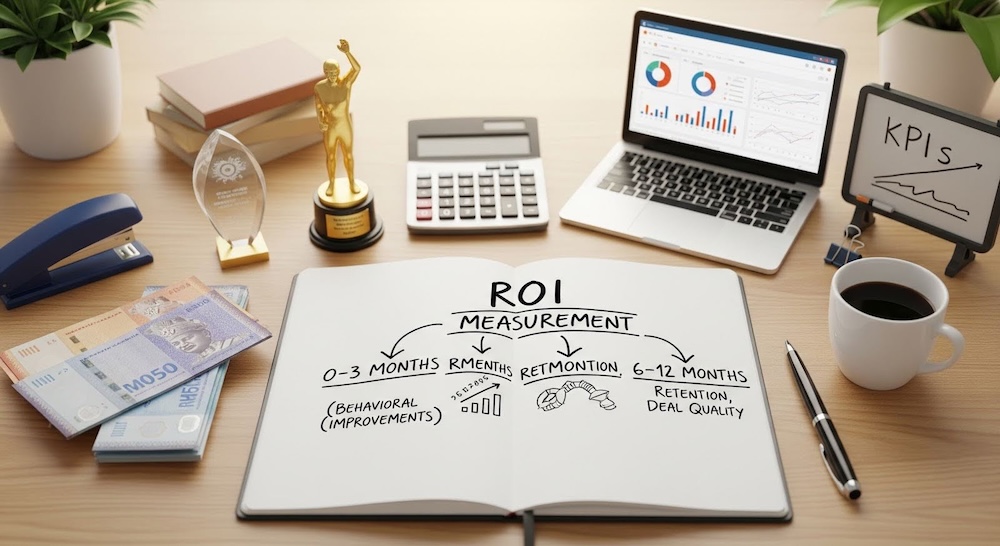
- ROI can be seen in stages, from early behavioural improvements (0–3 months) to long-term gains in revenue, retention, and deal quality (6–12 months).
- Key metrics include revenue growth, conversion rates, sales cycle efficiency, deal value, and sales behaviours.
- Pre- and post-training measurement is essential for linking training to real business outcomes and guiding future learning investments.
- Joint sales and marketing workshops enhance measurement by aligning goals, creating shared KPIs, and improving funnel visibility.
- Thriving Talents’ award-winning programmes are built to deliver measurable results, helping companies close capability gaps and drive sustainable growth.
Introduction
Sales training is an investment, not a cost. Yet many Malaysian business leaders still struggle to clearly explain what they are getting back from their sales training spend.
Too often, sales training is approved based on good intentions rather than clear outcomes.
As of 2026, Malaysia’s Wholesale & Retail trade reached a monthly sales value of RM160.9 billion (a 7.2% year-on-year increase). In such a high-value market, even a 1% improvement in sales efficiency via training results in millions in reclaimed revenue.
Leaders know training is important, but when budgets are tight, they are asked the same question: What is the return?
Measuring the right sales metrics helps leaders justify training budgets, make better decisions, and ensure sales development efforts lead to real business results.
What Is Sales Training ROI and Why It Matters?
Sales training ROI (Return on Investment) shows whether training improves real sales performance, not just knowledge or motivation. It looks at what actually changes after training—how salespeople behave, perform, and deliver results.
When ROI is measured properly, conversations move away from “feel-good training” and towards measurable business impact. Leaders can see whether training improves conversion rates, deal quality, or revenue growth.
In Malaysia, business leaders face increasing pressure to justify training spend. With rising costs and competitive markets, sales training must show clear value to the organisation.
Also read: What Is Sales Training? A Complete Guide for Malaysian Corporates.
How Long Does It Take to See Sales Training ROI?
Sales training ROI does not happen overnight. The timeline depends on the type of training, the level of reinforcement, and how performance is measured.
- Short-term (0–3 months): Early signs appear in behaviour changes, higher confidence, and better-quality sales conversations.
- Mid-term (3–6 months): Improvements become visible in conversion rates, deal quality, and healthier sales pipelines.
- Long-term (6–12 months): Stronger impact shows up in revenue growth, customer retention, and more consistent sales performance.
- Depends on training type: Skills-based and coaching-led programmes usually show results faster than one-off workshops.
Also read: How Often Should Companies Conduct Sales Team Training?
Why Measuring Sales Training ROI Is Often Overlooked?
Many organisations struggle with ROI measurement, not because it is impossible, but because it is often overlooked.
Organisations still measure training success by attendance or feedback forms, rather than actual performance change. While these metrics are easy to track, they do not show business impact.
Results also take time, and without a clear plan, post-training tracking is rarely done properly. In many cases, no one is clearly responsible for measuring outcomes after training ends.
Without data, leaders rely on assumptions instead of evidence, making it harder to justify future investments or improve training effectiveness.
Key Sales Metrics Malaysian Leaders Should Track
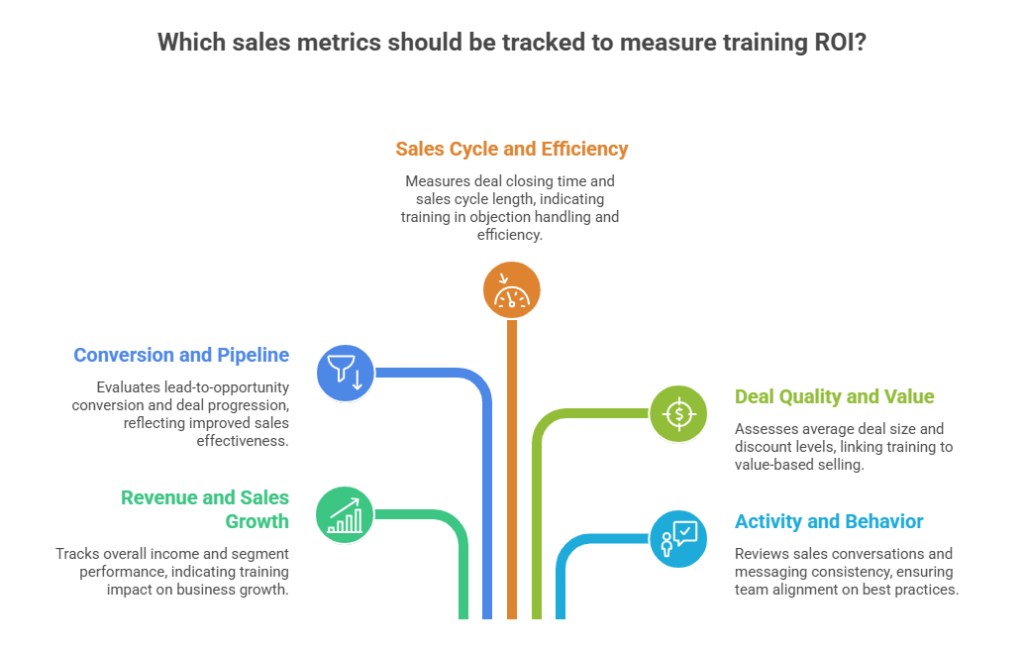
To measure sales training ROI, leaders need to focus on metrics that reflect real sales outcomes, not just activity.
Revenue and Sales Growth Metrics
- Overall sales revenue: Tracks the total income generated from sales over a period, serving as a direct indicator of training impact on business growth.
- Revenue growth by team, product, or territory: Measures how different segments perform post-training, helping identify where the training is driving success or where additional support may be needed.
Conversion and Pipeline Metrics
- Lead-to-opportunity conversion rates: Evaluates how effectively sales reps turn leads into qualified opportunities, often improving with better sales conversations and qualification skills.
- Win rates and deal progression: Assesses the percentage of deals closed from opportunities and how smoothly they move through the pipeline—key signs of improved sales effectiveness.
Sales Cycle and Efficiency Metrics
- Average sales cycle length: Measures the average time it takes to close a deal; shorter cycles typically reflect more confident, skilled selling.
- Time taken to close deals: Tracks how quickly sales reps can finalise deals, indicating efficiency gains from training in objection handling and deal-closing techniques.
Deal Quality and Value Metrics
- Average deal size: Evaluates whether reps are closing larger-value deals post-training, often linked to improved value-based selling skills.
- Discount levels and pricing discipline: Monitors reliance on discounts to close deals, with effective training leading to stronger negotiation and price integrity.
Activity and Behaviour Metrics
- Quality of sales conversations: Assessed through call reviews or client feedback, this reflects how well salespeople engage, ask questions, and deliver value.
- Consistency in sales messaging and sales process: Ensures all reps follow the same core messaging and steps, indicating that training has aligned the team on best practices.
These metrics help leaders see whether training is improving both how salespeople sell and what results they achieve.
Pre-Training vs Post-Training Measurement
To truly understand the effectiveness of sales training, businesses must measure impact at every stage—before and after the training takes place. Here’s how to set up a results-focused measurement approach that connects learning to performance.
Establishing a Clear Baseline
Before training begins, it is important to measure current performance. Understanding existing gaps and challenges helps define clear focus areas and training goals.
Choosing the Right Metrics to Measure
Choose key performance indicators (KPIs) that align with your business goals and training objectives. Avoid overcomplicating it. Stick to metrics that are simple, relevant, and meaningful.
Tracking Progress After Training
After training, short-term and medium-term changes should be monitored. This helps identify whether improvements are linked to training rather than external factors.
Aligning Measurement With Business Goals
Training outcomes should connect directly to business priorities such as growth, efficiency, or customer retention. Leadership alignment on success measures is critical.
Reviewing Results and Adjusting
Measurement should lead to action. Use the data to identify what’s working and where improvements are needed. This insight should inform your next training cycle, turning evaluation into a tool for continuous improvement.
Also read: Traditional vs Modern Sales Training Methods: Which Works Better in Malaysia?
Common Mistakes When Measuring Sales Training ROI
Measuring sales training ROI can easily go wrong without a clear approach. Many organisations fall into common traps that make it difficult to see the true impact of their training efforts.
- Measuring too many metrics at once
- Expecting immediate revenue increases
- Ignoring behaviour change and skill application
- Treating measurement as a one-time exercise
- Failing to establish a clear pre-training baseline for comparison
- Not aligning sales training metrics with broader business goals
- Leaving ROI tracking solely to HR without involvement from sales leaders
Also read: How to Conduct a Sales Training Needs Assessment for Your Business?
How Sales and Marketing Workshops Support ROI Measurement?
Joint sales and marketing workshops create alignment around shared goals and KPIs, making ROI easier to measure.
- They help both teams define success the same way, such as by tracking lead quality, pipeline velocity, and revenue contribution.
- When both teams speak the same language and follow consistent processes, training impact becomes more visible and measurable.
- Workshops that link marketing messaging to sales conversations improve consistency across the entire buyer journey.
- This structured, collaborative approach allows businesses to better track training effectiveness across the entire revenue cycle.
At Thriving Talents, our Sales Training and Workshops are designed with this in mind, ensuring that learning initiatives are aligned with business goals and supported by clear, measurable outcomes.
FAQ
How to calculate ROI on sales training?
Sales training ROI is calculated by comparing the improvement in sales performance (such as revenue or conversion rates) against the cost of training. The standard formula is: ROI = (Net training benefits – Training costs) ÷ Training costs × 100.
What is a good ROI in training?
It varies by industry, but a 3:1 ratio (300% return) is often considered strong. More important than the ratio is proving that training outcomes align with strategic business goals.
Can sales training ROI be measured without revenue data?
Yes. Behaviour change, conversion rates, deal quality, and pipeline health are strong indicators of training impact.
How to measure sales training effectiveness?
Track changes in knowledge, skills, behaviours, and business outcomes. Use pre/post assessments, manager feedback, CRM data, and KPI dashboards.
Which sales KPIs best show training impact?
Ultimately, the ROI of sales training depends on measuring the right things—not just who attended, but what changed. When leaders track clear KPIs, training shifts from being a cost to becoming a strategic business investment.
Organisations that measure consistently and align learning with business outcomes make smarter training decisions and drive stronger performance over time.
Recognised with double Gold Awards at the HR Vendors of the Year 2025, Thriving Talents creates sales development programmes that deliver measurable business results, turning insights into practical strategies that close performance gaps, strengthen sales teams, and drive long-term success.
Want to see measurable ROI from your sales training? Let us help you build a high-impact, results-driven sales team built for Malaysia’s relationship-first market. Explore our approach here.
Conclusion
The effectiveness of sales training depends on how well it reflects the real world your team operates in. In Malaysia’s relationship-first, multi-cultural environment, traditional approaches often fall short not because they’re outdated, but because they overlook the human, contextual, and cultural dynamics at play.
Modern sales training, on the other hand, focuses on behavioural change, practical scenarios, and emotional intelligence—elements that directly align with how business is done here. When training reflects the way your team actually sells, it creates real impact.
This is why partnering with the right training provider matters.
At Thriving Talents—winner of two Gold Awards at the HR Vendors of the Year 2025, including Best Sales Training Provider—we design sales programmes grounded in behavioural science, market relevance, and local business realities.
Looking to modernise your sales training? Thriving Talents delivers locally relevant, high-impact programmes built for Malaysia’s relationship-driven market. Explore our approach here.