Key takeaways:
- Scaling a sales team requires more than hiring. It involves building the right culture, processes, and technology to ensure consistent performance.
- Strong sales culture starts with leadership that prioritises coaching, psychological safety, and clear performance expectations.
- Structured sales processes and playbooks help standardise selling approaches, reducing reliance on individual “superstars.”
- Sales technology, including AI-powered simulations, enables scalable coaching and continuous skill development across teams.
- Organisations that invest in structured sales capability development are better positioned to maintain consistency and drive growth while scaling.
- Thriving Talents supports organisations in scaling their sales teams through experiential learning and simulation-based training that drives real behavioural change and performance improvement.

Introduction
Scaling a sales team has become more complex in today’s business environment.
As of 2026, buyers are more informed, more selective, and expect greater value before making purchasing decisions. In many industries, even small improvements in sales effectiveness can lead to significant revenue impact, especially in high-value markets.
Yet many organisations still struggle to scale effectively. Hiring more salespeople does not automatically lead to better results. Without the right structure, growth often creates inconsistency instead of performance improvement.
To scale successfully, organisations need to focus on more than headcount. They must build a strong sales culture, implement structured processes, and leverage the right technology.
This is what enables teams to grow while maintaining consistency, improving customer experience, and driving sustainable results.
What Does It Mean to Scale a Sales Team?
Scaling a sales team means expanding your team’s capacity while maintaining or improving performance, consistency, and customer experience.
It is not just about hiring more salespeople. It involves strengthening skills, standardising processes, and building systems that support sustainable growth.
In practice, scaling includes:
- Hiring and onboarding new sales talent
- Developing consistent selling capabilities
- Implementing structured sales processes
- Leveraging technology to support performance
- Ensuring alignment between sales activity and business goals
Why Scaling Sales Teams Is More Challenging Today?
In today’s environment, buyers are more informed and more cautious.
This means sales teams must do more than present products. They need to demonstrate value, build trust, and guide customers through decision-making.
Without the right structure, scaling can lead to:
- Inconsistent customer experiences
- Unpredictable sales performance
- Longer sales cycles
- Reduced conversion rates
This is why organisations need a structured approach to scaling.
Consultative Sales:
Salespeople have to now shift from being product-pushers to highly skilled consultants that probe and add value in each conversation to help clients understand the value they bring to the table. They also have to make sure they differentiate in a relevant way to show they are better than the competition in some advantageous way.
For sales leaders, the pressure can be intense. Not only must you do this with a few superstars on your team, but you need to scale these to all salespeople on your team to keep cash flowing into the organization while meeting your overall sales targets.
So, how can you start doing this with your team?
A Structured Approach to Scaling Your Sales Team
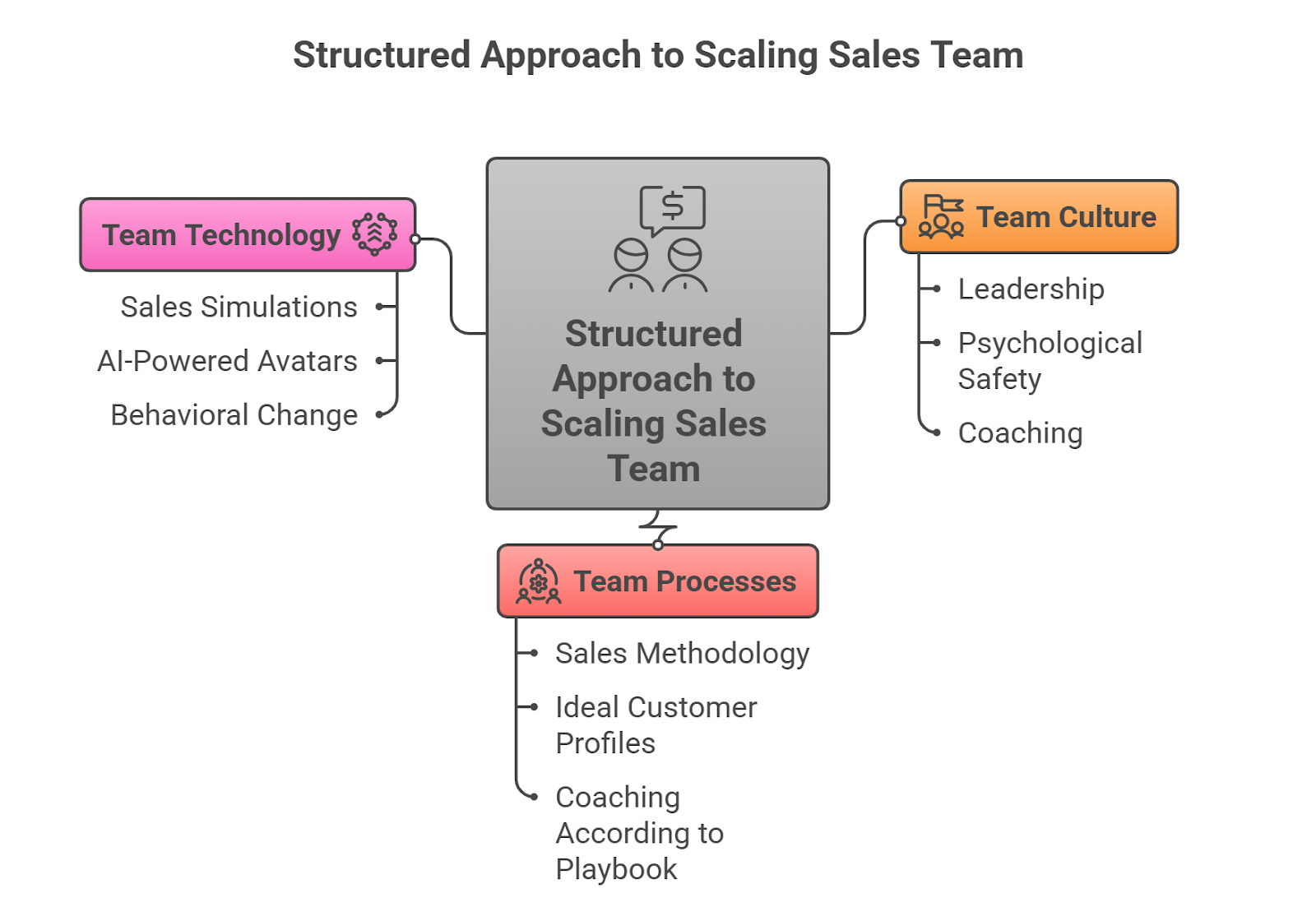
Image: The three main components of scaling a sales team
There are three main components to consider when scaling a sales team effectively:
- Team Culture
- Team Processes
- Team Technology
Together, these elements form the foundation for sustainable sales performance.

Team Culture
Leaders should act like leaders and not individual contributors.
Sometimes, leaders fall into the trap of wanting to outshine their team members, which is a big mistake.
Team leaders set the culture by defining what success looks like by measuring, rewarding, and recognising it.
They create a psychologically safe environment and, more importantly, coach their people to reach their targets. Like athletic coaches, they focus on behaviours, mindset, and emotional influence to drive performance.
Team Processes
To scale effectively, leaders need structured playbooks-sales methodology, tactics, processes, and techniques that help the sales team members.
Sales leaders need to provide a clear step-by-step process on how to open the conversation and how to close the sale based on pre-defined ideal customer profiles.
This ensures consistency and scalability across their teams.
You should not rely on a single team lead using an idiosyncratic way of selling to specific customers. Instead, all team members should follow a clear and consistent path aligned with your target customer segments.
Another key element for a sales leader is coaching according to the playbook. This involves technical skills, conversational questions, mindset, attitudes, and the ability to influence – on an emotional level – in order to motivate coachees for success.
Team Technology
Sales leaders should leverage technology to scale their efforts. No leader can coach every team player when they need support. Technology helps bridge this gap.
For example, AI-powered sales simulations allow team members to practise conversations in a safe environment.
These simulations enable salespeople to:
- Practise handling objections
- Test different sales approaches
- Improve confidence through repetition
- Get certified on product knowledge
These simulations have proven to be a powerful tool for behavioural change that leaders can leverage for scaling their sales coaching.
Why Sales Training Is Critical When Scaling a Sales Team?
As teams grow, gaps in capability become more visible.
Without structured sales training:
- New hires take longer to become productive
- Sales conversations become inconsistent
- Customer experiences vary across the team
- Performance becomes harder to manage
Modern sales training helps address these challenges by developing practical skills, reinforcing consistent behaviours, and supporting continuous improvement.
Also read: How Often Should Companies Conduct Sales Team Training?
Scaling Sales Teams in the Malaysian Market
Scaling a sales team in Malaysia requires an understanding of local business culture.
Success often depends on:
- Relationship-driven selling
- Trust-building before closing
- Adapting communication styles across industries
- Understanding diverse customer expectations
Training and processes must reflect these realities to remain effective.
FAQ
How do you scale a sales team effectively?
Scaling a sales team requires a combination of hiring, structured onboarding, capability development, and performance tracking.
What is the most important factor when scaling a sales team?
The most important factor is consistency. Without consistent processes and skills, growth can lead to unpredictable results.
Why is technology important in scaling sales teams?
Technology helps automate processes, improve visibility, and enable scalable coaching through tools such as CRM systems and simulations.
How does sales training support scaling?
Sales training ensures that all team members follow consistent approaches, improving performance and customer experience.
What are the biggest mistakes when scaling a sales team?
Common mistakes include hiring too quickly without proper onboarding, relying on individual sales styles instead of structured processes, and failing to invest in training and coaching. These issues often lead to inconsistent performance.
How can companies maintain sales performance while scaling?
Companies can maintain performance by standardising sales processes, investing in continuous training, and using technology to track and support sales activities. Consistency is key to scaling successfully.
When should a company start scaling its sales team?
A company should scale its sales team when it has a proven sales process, clear target customers, and consistent performance. Scaling too early without these foundations can lead to inefficiencies.
Conclusion
In summary, to compete and increase profits, sales leaders need to scale their sales teams.
They need to focus on shaping the right sales culture and processes whilst leveraging technology to ensure success and compete to survive and thrive in the next normal.
Organisations that take a structured approach are better positioned to adapt, compete, and grow in today’s evolving market.
Recognised as a double Gold Award winner at the HR Vendors of the Year 2025, Thriving Talents supports organisations in scaling their sales teams through experiential learning and simulation-based training that drives real behavioural change and performance improvement.

Thriving Talents is committed to bringing learning technologies to life. If you are interested to know more on how to scale your sales team and leverage on simulations for sales teams powered by A.I, do reach out to us at whatsup@thrivingtalents.com